You probably track more things than you realize.
If you are in your late 20s, banking apps track where your money keeps disappearing every month, and fitness apps will remind you when you consume too much sugar on the weekend.
As a corporate girlie, tracking everything is a part of my professional life as well. But why do we track so much? For me, it helps me notice patterns that I would have missed otherwise. And these in turn help me make good decisions.
But there’s one part of life that most people never think to track: Their relationship.
Of course, tracking your relationship does not mean counting who paid where or who did more chores. In a healthy relationship, you don’t need to compete.
A relationship tracker is something entirely different.
It’s a simple way to notice the small habits that shape your relationship over time: The conversations before bed. The moments of appreciation. Even the unresolved arguments and the shared laughs that make difficult weeks feel lighter.
While these moments rarely seem important on their own, together, they tell the story of your relationship.
Can you honestly remember how often you spent uninterrupted time together? Or whether your conversations have become deeper or shorter? Most of us rely on memory to answer those questions.
The problem is that memory isn’t always reliable.
We tend to remember emotional moments. For instance, a painful argument stays with us far longer than ten ordinary evenings spent talking over dinner. Similarly, we often overlook the small acts of kindness that quietly strengthen a relationship every day.
That’s why a relationship tracker can be so valuable. It doesn’t measure love. Instead, it measures habits.
And habits are something you can improve.
Key Highlights:
Whether you’ve been together for six months or twenty years, tracking healthy relationship habits can help you:
- Spot problems early,
- celebrate progress, and
- have more meaningful conversations about where your relationship is heading.
In this guide, I’ll break down what a relationship tracker really is, why it works, how to build one that fits your relationship, and which daily habits matter most.
Also, I’ve added a practical template, reflection questions, and a simple framework that turns relationship check-ins into something you actually look forward to.
Stay tuned.
What Is A Relationship Tracker?
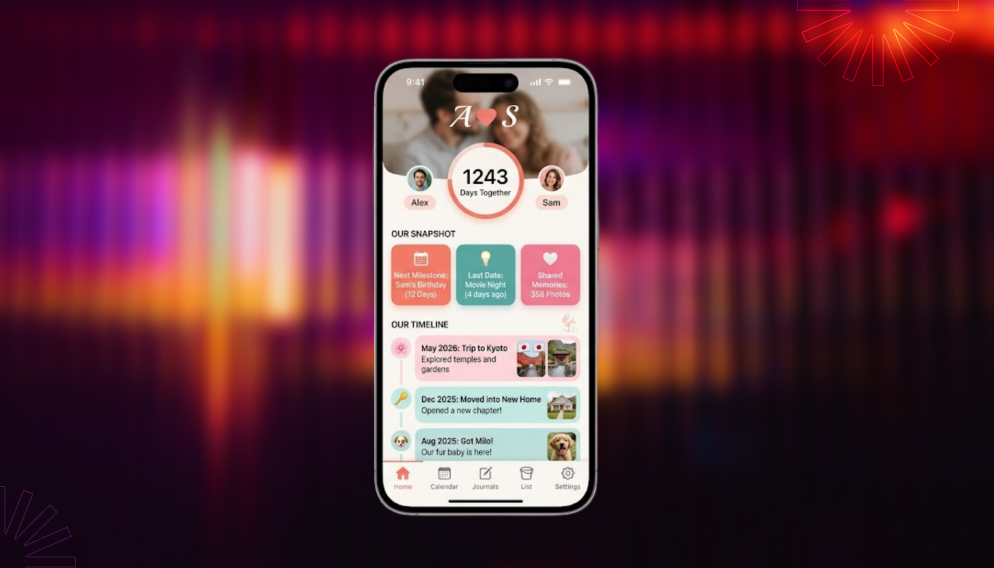
A relationship tracker is a tool that helps couples reflect on the habits, behaviors, and experiences that influence their relationship over time.
The keyword here is reflect.
Many people hear the word tracker and immediately think of monitoring someone else’s behavior. They imagine checking phone locations, reading messages, or keeping score after every disagreement.
That’s not what this is about.
Moreover, any healthy relationship tracker focuses on the relationship itself, not on controlling either partner.
Instead of asking, “What did my partner do wrong?” it asks questions like:
- Have we spent enough quality time together this week?
- Are we communicating openly?
- Have we shown appreciation for each other?
- Did we resolve disagreements respectfully?
- Are we making time for shared goals?
Those questions encourage awareness rather than blame. That’s an important difference. For example, imagine two couples have the same disagreement.
The first couple argues, moves on, and forgets about it. But the second couple notices that they’ve argued over the same issues for three weeks in a row. Their tracker reveals a pattern.
Instead of focusing on the latest argument, they talk about the underlying problem. The disagreement becomes a conversation instead of another conflict.
That’s the real purpose of a relationship tracker – It helps you see patterns that are difficult to notice in everyday life.
Who Can Benefit From A Relationship Tracker?
You don’t have to be struggling to use one.
In fact, the healthiest relationships often grow because both partners pay attention before small issues become major ones.
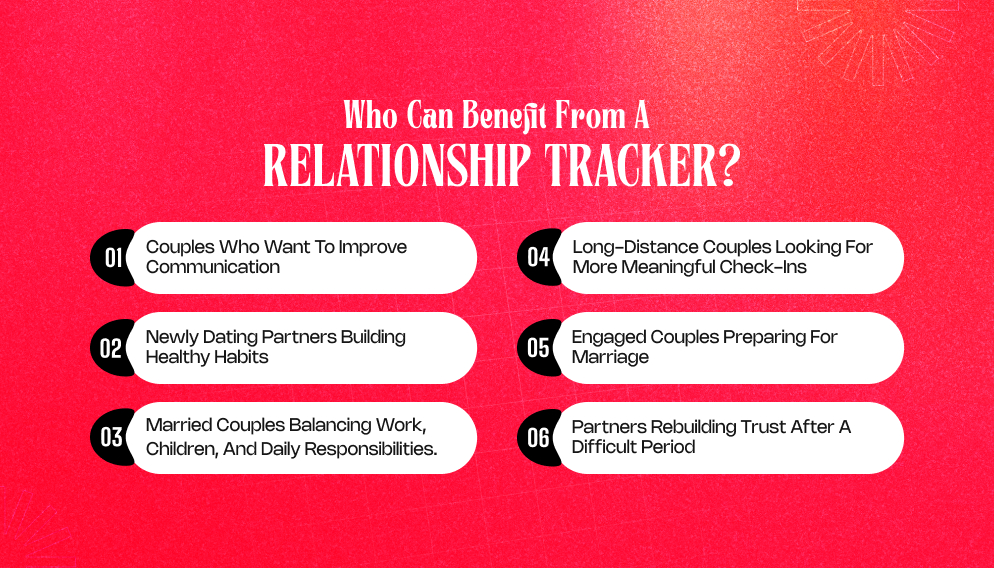
As a result, a relationship tracker can be useful for:
- Couples who want to improve communication.
- Newly dating partners building healthy habits.
- Married couples balancing work, children, and daily responsibilities.
- Long-distance couples looking for more meaningful check-ins.
- Engaged couples preparing for marriage.
- Partners rebuilding trust after a difficult period.
The format may change, but the goal stays the same – to create more awareness, build better habits, and strengthen the relationship over time.
Why Tracking A Relationship Actually Works?

At first, the idea may sound unusual. I mean, when you think about it, love doesn’t seem like something you should measure.
In reality, you’re not measuring love at all. You are paying attention to the behaviors that help love grow.
Psychologists have long known that people struggle to judge long-term patterns from memory alone. We naturally give more weight to recent events and emotionally charged experiences.
For instance, a single argument at the end of the week can make the entire relationship feel worse than it really is, while weeks of positive interactions fade into the background because they feel ordinary.
Now, a relationship tracker helps balance that perspective.
Instead of relying on emotion alone, you create a simple record of the habits that matter.
Maybe you discovered that you’ve had meaningful conversations almost every day, even though the week felt stressful.
Or perhaps you realized that quality time has slowly disappeared because work has become busier than usual.
Neither discovery is about assigning blame. Both create an opportunity to make intentional changes.
Small Habits Create Strong Relationships:
Most relationships don’t become stronger because of one grand romantic gesture. They improve because of small actions repeated consistently.
So, it could be like anything:
- A genuine compliment before work.
- Putting your phone away during dinner.
- Checking in after a difficult meeting.
- Saying thank you for everyday tasks.
- Listening without interrupting.
None of these moments seems remarkable on its own. But together, they create trust, emotional safety, and connection.
A relationship tracker helps you notice whether those habits are becoming more frequent or quietly disappearing. That’s information most couples never stop to collect.
Tracking Creates Conversations, Not Scores:
One of the biggest myths about relationship tracking is that it encourages competition. Ideally, it shouldn’t.
So, if one partner starts keeping score, the tracker has already failed. Think about it: a healthy tracker isn’t a report card. Rather, it’s a conversation starter.
Instead of saying, “You never spend time with me anymore,” you can say, “We’ve only had one uninterrupted evening together this month. How can we make more time for each other?”
The discussion becomes more balanced because you’re talking about shared habits rather than personal flaws.
That’s why the best relationship trackers focus on progress, not perfection. Their purpose isn’t to prove who’s right. Rather, it’s to help both partners grow together.
You May Also Like: How Smart Devices Affect Relationships: The Good, The Bad, And What Research Says
The Relationship Health Wheel: Five Habits That Shape Every Healthy Relationship
No relationship stays strong because of one big romantic gesture. It stays strong because of small habits repeated over time.
For me, a surprise vacation is memorable. So is an expensive anniversary gift. But neither can make up for months of poor communication or emotional distance – it just doesn’t cut it for me.
That’s why a relationship tracker shouldn’t focus on isolated moments – my tracker focuses on patterns of consistency.
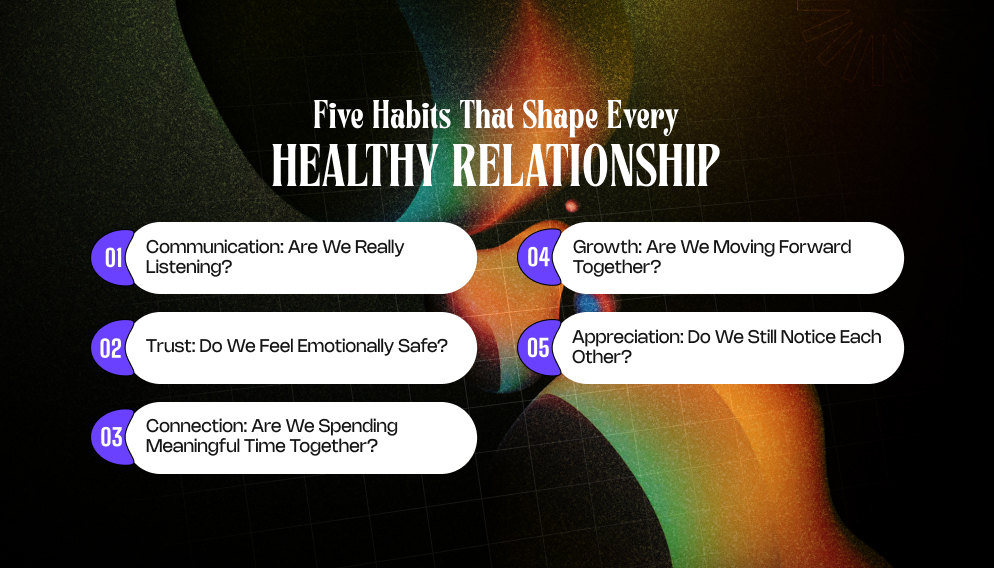
FYI, the Relationship Health Wheel is a simple framework that helps you evaluate the five areas that influence almost every relationship. So, you can think of it as a monthly health check rather than a test you have to pass.
If one area feels weaker than the others, it doesn’t mean your relationship is failing. It simply shows where your attention is needed.
(Source: Reproductive Health National Training Center)
1. Communication: Are We Really Listening?
Every healthy relationship begins with honest communication. But communication isn’t just about talking. You can’t keep talking – you need to pause and listen too!
Many couples speak every day, yet still feel disconnected because most conversations revolve around schedules, chores, bills, or work. Those conversations matter. But they aren’t enough on their own.
Healthy communication also includes curiosity: How was your day? Or what’s been on your mind lately? Sometimes, simple questions like these reveal much more than long conversations once a month.
2. Trust: Do We Feel Emotionally Safe?
Trust is often misunderstood. People usually associate it with honesty or faithfulness. And those are certainly part of it.
But trust also means knowing you can be vulnerable without fear of judgment: Can you admit you’ve made a mistake? Can you disagree without wondering if the relationship is at risk?
If the answer is yes, emotional trust is probably strong. But if the answer is no, it’s worth exploring why. Remember, trust grows through consistency.
3. Connection: Are We Spending Meaningful Time Together?
Being in the same room isn’t the same as spending quality time together. Many couples spend hours side by side while scrolling through different screens.
They’re physically close but emotionally distant. Connection grows when you intentionally share experiences.
That doesn’t always require elaborate date nights. Sometimes it’s cooking dinner together, taking an evening walk, or even watching a favorite movie.
4. Growth: Are We Moving Forward Together?
Every relationship changes. The question is whether you’re growing together or drifting apart. Growth doesn’t always mean buying a house, getting married, or having children.
Sometimes it means learning a new hobby together. Supporting each other’s careers, planning a trip, or even saving for a shared goal.
Healthy couples don’t just solve today’s problems. They create tomorrow’s plans.
5. Appreciation: Do We Still Notice Each Other?
This is often the first habit to disappear. Not because people stop caring. But because they become comfortable.
Comfort is wonderful. But taking someone for granted isn’t. Moreover, acts of kindness slowly become expectations. Over time, both partners may begin to feel unseen.
Appreciation interrupts that pattern. It reminds your partner that their efforts still matter.
Also Check: Apps For Couples: The Digital Tools That Can Actually Make Life Together Easier
How To Use The Relationship Health Wheel?
Once a week, or at least once a month, rate each area on a scale from 1 to 5.
| Relationship Area | Score (1–5) | Reflection |
| Communication | Did we talk openly this week? | |
| Trust | Did we feel emotionally safe with each other? | |
| Connection | Did we spend meaningful time together? | |
| Growth | Are we working toward shared goals? | |
| Appreciation | Did we express gratitude and affection regularly? |
Don’t worry about getting perfect scores. The goal isn’t perfection. Instead, the goal is awareness. So, if communication scores a three this month and a four next month, you’re moving in the right direction.
But if appreciation keeps dropping, you’ve identified something worth discussing before resentment builds.
That’s the real strength of the Relationship Health Wheel. It turns vague feelings into meaningful conversations.
Instead of asking, “Is our relationship okay?” you can ask, “Which part of our relationship needs a little more attention right now?”
That simple shift makes conversations feel less defensive and far more productive.