I’ve always been somewhat fascinated with the concept of boundaries.
I mean, why is it so hard to explain to some people that boundaries are subjective and vary depending on the people and situations?
And things are only getting more screwed up in a digital context – 10 years ago, I was only worried about the awkward conversation with a friend who didn’t understand I didn’t like her touching my food every time we would eat.
But now I’m concerned about colleagues who think it’s okay to text me at 12 a.m. and ask for some updates – isn’t that very problematic?
And it’s not just my colleagues; I’ve so many acquaintances who have asked me why I didn’t reply to their text on Instagram when I was
TBH, I love technology and how it helps us stay connected. But technology has also set these unacceptable expectations – if you are online, you should be able to reply.
It has become so hard to disconnect – work will follow you home, friends will want quick replies, and social media just doesn’t know when to stop.
I feel that the line between our offline and online worlds is getting a little more blurry every day.
This is exactly where the concept of digital boundaries steps in – and it’s my job to keep talking about it till people finally understand that boundaries don’t just exist in the real world – they exist in the virtual world as well.
Moreover, people often confuse digital boundaries with uninstalling a bunch of apps and reducing screen time. Instead, it is about controlling your availability and how easily people can contact you.
In this context, I will break down digital boundaries in detail, highlighting how you can set realistic, healthy boundaries to protect your time and relationships.
Stay tuned.
What Are Digital Boundaries?

I have always looked at boundaries as a set of expectations that I created for myself and anyone who interacts with me.
In that case, digital boundaries are also the same thing – only in this case, these boundaries are specifically applicable to any interaction I have virtually.
So, it could be applicable for any interactions on social media or your Teams chat, and anything that is dependent on technology.
Moreover, you can also look at these boundaries as something that defines how you engage with tech instead of letting tech dictate different moments in your life.
I don’t know why nobody is talking about how simple these boundaries can ideally be. For instance, when I work, I put my phone on DND so that no notifications can irritate me me – as a writer, it is extremely disturbing when notifications keep distracting me.
Then, when I am home after a long day at work, I put my phone on Flight Mode and connect to the WiFi – so that I can peacefully scroll on my phone without worrying about people calling me.
And not just that, as a self-proclaimed Instagram addict, I love looking at good content on the gram.
But the issue is people send me reels and normal messages, expecting me to reply immediately. So, my Instagram is on Sleep Mode between 9 PM and 9 AM.
Now, you might think I am ignoring people consciously. TBH, I’m not. Because I am just creating some much-needed boundaries for my peace and privacy.
Additionally, I also think these boundaries have a clear impact on what you are sharing online, or who can see the content you are sharing.
In the absence of clear boundaries, it feels like you are always available, and that can get really exhausting.
Why Digital Boundaries Matter More Than Ever?

A generation ago, leaving the office usually meant work stayed at the office. Friends called the house phone. Similarly, family wouldn’t expect quick replies during the day.
But now, things are very different – you can get an email at any hour of the day. Your WhatsApp groups are active throughout the day. And social media just never stops.
For the longest time, I didn’t even know how hard it has become to focus, thanks to so many notifications. And this is not just applicable to my phone.
When I am working on my laptop, it’s the same thing – my Teams chat keeps popping up, my tools keep sending me alerts about new updates, and my social media team keeps irritating me with new trends.
So, when things got really overwhelming for me, I realized that I can’t focus for hours anymore – I have to check my Teams or my phone for some notification. Checking the device had become more of a habit, and I hated it.
Frankly, the problem isn’t the technology here – it has made life so easy that I am not going to complain about it. The real problem is the constant access and availability – the issue is that every notification has started feeling urgent.
As a result, we have forgotten when we are on the clock, and more importantly, when we are off it!
And this is where healthy digital boundaries start to matter – they are a reminder that every notification on your phone doesn’t need a response immediately.
Signs Your Digital Boundaries May Need Attention
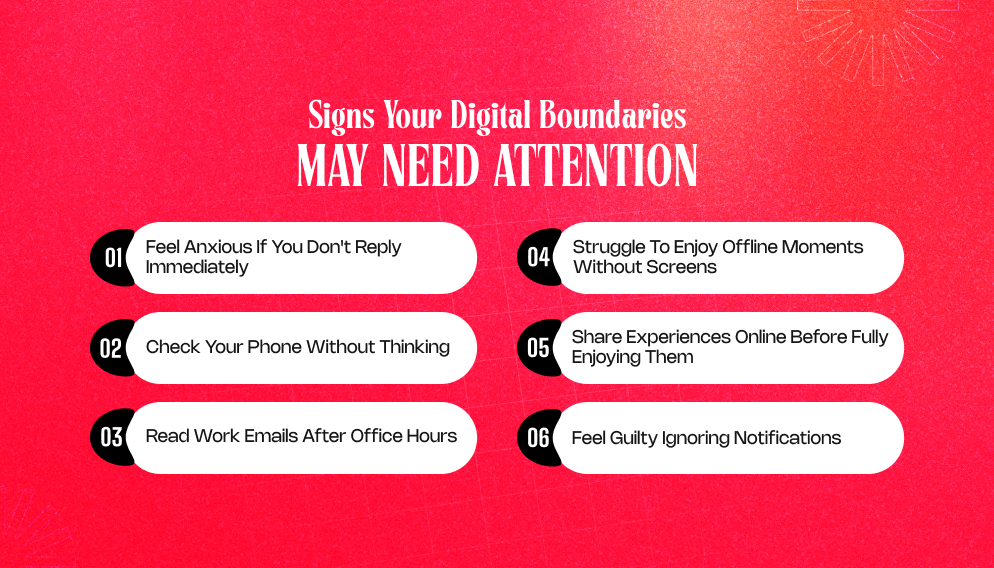
Sometimes the biggest clue is how you feel.
If technology leaves you mentally drained instead of helping you stay connected, it may be time to rethink your habits.
You might benefit from stronger digital boundaries if you:
- Feel anxious when you don’t reply to messages straight away.
- Check your phone without thinking, even during conversations.
- Struggle to stop reading work emails after office hours.
- Find it difficult to enjoy meals, holidays, or weekends without looking at your screen.
- Share personal moments online before you’ve had time to enjoy them yourself.
- Feel guilty whenever you ignore a notification.
None of these habits make you irresponsible. They simply show how easy it is to slip into patterns that keep you constantly connected.
The good news is that small changes often make a noticeable difference.
You don’t have to overhaul your entire digital life overnight.
A few thoughtful boundaries can create more space for rest, focus, and the people sitting beside you.
What Healthy Digital Boundaries Actually Look Like
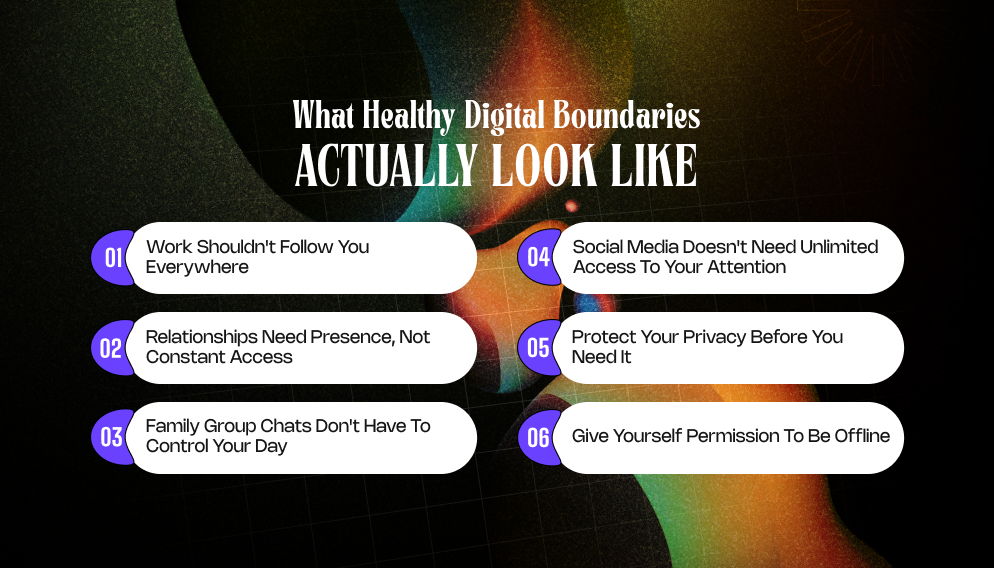
Talking about digital boundaries is easy. But living by them is another story.
Nobody actually wakes up one fine morning and decides they will spend the next 10 hours in front of a screen – it happens so subtly that nobody notices it until they are in too deep.
One day, you have a lot of work, and you will think it’s fine to reply to a few emails before dinner. The next day, you will think it’s fine to get on a client call since you have some free time.
And soon, you will see you are working every day and sacrificing your free time in front of a screen. These are all habits that build quietly. So do the expectations.
That is why healthy digital boundaries are not dramatic – they are actually small decisions that you end up repeating until they become a part of your daily routine!
1. Work Shouldn’t Follow You Everywhere:
Work has become portable. That’s useful until it isn’t.
Years ago, leaving the office meant the working day had ended. Today, your laptop comes home with you, and your phone makes sure work never feels too far away.
The difficult part is that most after-hours messages aren’t emergencies – they are simply convenient for the person sending them. That doesn’t automatically mean they’re convenient for you.
So, if your company doesn’t expect employees to be available all evening, you don’t need to create that expectation yourself.
One simple boundary could be deciding that emails received after working hours can wait until the next morning.
Another might be switching off work notifications during dinner or while spending time with your family.
People often worry this makes them look uncommitted. In reality, consistently producing good work matters far more than replying to a message at 9:30 p.m.
Being available every minute isn’t the same as being dependable.
2. Relationships Need Presence, Not Constant Access:
Many couples spend more time connected than ever before. Ironically, that doesn’t always make them feel closer.
It’s easy to assume that love means sharing everything – Every password, location, conversation, and literally every moment of the day.
But healthy relationships aren’t built on unlimited access – They’re built on trust. For one couple, a healthy boundary might mean putting both phones away during dinner.
For another, it could mean agreeing not to expect immediate replies while the other person is at work.
Some couples love posting every holiday online. Others prefer to keep those memories to themselves.
Neither approach is right or wrong.
The important part is making those decisions together instead of assuming your partner should naturally see things the same way.
3. Family Group Chats Don’t Have To Control Your Day:
Family chats are wonderful. They’re also relentless – One photo turns into twenty messages. Someone asks a simple question.
Before long, fifty new notifications are waiting. You don’t have to answer every message the moment it arrives. Most conversations can wait until you’re free.
So, if you always interrupt your work, meals, or personal time to keep up with every discussion, you’re teaching yourself that every notification deserves immediate attention.
Very few actually do. Sometimes it’s perfectly reasonable to mute a group for a few hours and return when you have the time and energy to join the conversation properly.
4. Social Media Doesn’t Need Unlimited Access to Your Attention:
Social media isn’t designed to remind you to stop scrolling. It rewards the opposite. And that’s why so many people open one app for a minute and lose half an hour without noticing.
A healthier boundary isn’t necessarily deleting every account. It might be deciding not to check social media first thing in the morning.
Or keeping your phone in your pocket when you’re having coffee with a friend. Or refusing to measure your day by likes, comments, and notifications.
Those habits sound small. Together, they change how much space social media occupies in your life.
5. Protect Your Privacy Before You Need It:
Digital boundaries aren’t only about time. They’re also about information. Every photo, location tag, birthday post, or public update reveals something about you.
On its own, that may not seem important. Taken together, it creates a detailed picture of your life. That doesn’t mean you should stop sharing altogether.
It simply means asking yourself one question before posting: “Would I still be comfortable with this if someone I didn’t know saw it?”
If the answer is no, waiting a little longer or sharing it with a smaller audience may be the better choice.
Privacy isn’t about secrecy. Instead, it’s about deciding who gets access to different parts of your life.
6. Give Yourself Permission To Be Offline
Perhaps the hardest boundary to set is the simplest one – Doing nothing. No scrolling. No replying. And no catching up.
Just being unavailable for a while.
Many people feel guilty when they don’t answer messages immediately. Others worry they’ll miss something important. Usually, they don’t.
The world carries on remarkably well without us checking our phones every few minutes. The people who genuinely matter will still be there when we come back.
Sometimes the healthiest digital habit isn’t downloading another productivity app.
It’s leaving your phone in another room while you enjoy dinner, read a book, take a walk, or have a conversation that isn’t interrupted by a vibrating screen.
Those moments are becoming surprisingly rare – Which is exactly why they’re worth protecting.
You May Also Like: Apps For Couples: The Digital Tools That Can Actually Make Life Together Easier
Digital Boundaries: Key Takeaways!
None of these boundaries require expensive apps or complicated systems. They are small choices.
- Leave your phone in another room while eating dinner.
- Answer work emails tomorrow instead of tonight.
- Mute a group chat until you’re free.
- Put your screen away when someone is talking to you.
Individually, those decisions don’t seem life-changing. Together, they create something many of us don’t realize we’ve been missing.
A little more attention. A little more quiet. And a little more control over how we spend our days.