
Most people think physical intimacy is something that either exists or doesn’t.
They treat it as a separate part of a relationship, almost like a switch that can be turned on when the mood feels right.
But, real relationships rarely work that way. Physical intimacy does not begin when two people get into bed together. Instead, it often begins much earlier.
It starts in ordinary moments that seem unrelated to romance. Moreover, it grows through trust, attention, appreciation, and emotional closeness.
It weakens through unresolved conflicts, stress, resentment, and disconnection.
This is why many couples become confused when intimacy fades. They may still love each other. They may still find each other attractive. Yet something feels different.
The mistake is assuming the problem exists only in the bedroom.
In many cases, physical intimacy simply reflects what is happening throughout the rest of the relationship.
As a result, if you want to know how to improve physical intimacy, it helps to look beyond physical affection itself.
Sometimes the solution has less to do with attraction and more to do with how two people connect during everyday life.
In my blog, I’ll discuss how you can improve physical intimacy in your relationship
Physical Intimacy Is Often A Reflection Of Relationship Health:

So, think about the strongest relationships you know.
The couples who seem connected are usually not connected because they constantly plan romantic evenings. More often, they make each other feel valued during ordinary days.
They listen when the other person speaks. They show appreciation. More importantly, they support each other during stressful periods.
Also, they handle disagreements without turning every conflict into a personal attack.
Physical intimacy tends to grow naturally in relationships where both people feel emotionally secure. Plus, it becomes difficult when the relationship itself feels strained.
Many people try to fix intimacy without addressing the tension that exists underneath it. That approach rarely works for long because the underlying issue remains untouched.
As a result, before asking how to improve physical intimacy, ask a different question: How healthy does the relationship feel outside the bedroom?
The answer often reveals more than people expect.
How To Improve Physical Intimacy?
That was hard, I know. Nobody really wants to admit that something is grievously wrong in their relationship.
But the reality is that if you guys have stopped being physically intimate, then that clearly indicates something is very wrong in your relationship.
Having said that, you can improve physical intimacy in the relationship, provided both of you want to try, and there is no third person in the relationship.
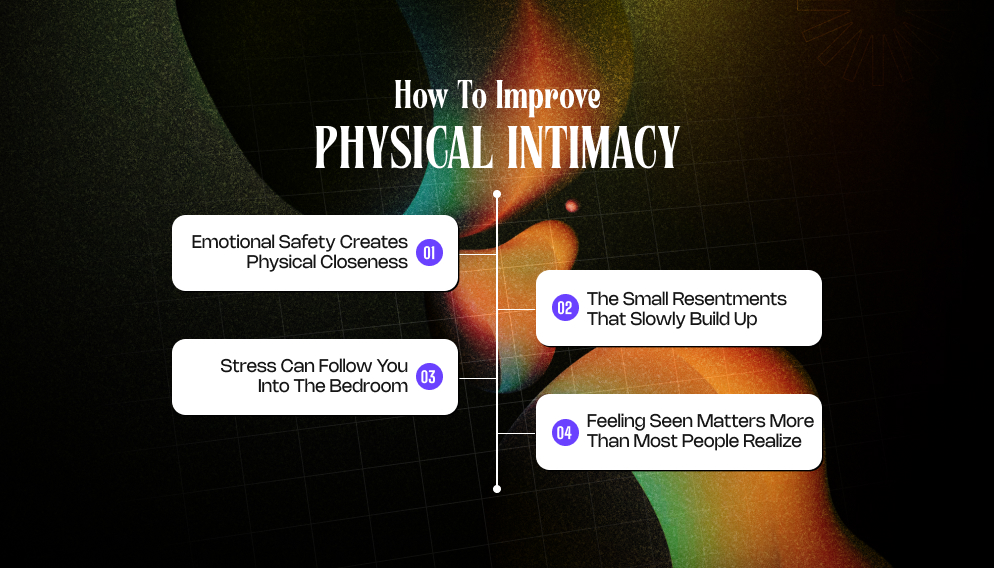
Emotional Safety Creates Physical Closeness:
Attraction matters. Chemistry matters. But emotional safety matters too.
TBH, people often feel more open to physical intimacy when they feel accepted rather than judged.
But imagine two different situations.
In the first relationship, one partner frequently criticizes the other. Moreover, small mistakes become arguments, while vulnerabilities are used against each other during disagreements.
However, in the second relationship, both people feel comfortable expressing concerns without fear of humiliation or rejection.
Which relationship is more likely to foster genuine intimacy?
The answer is obvious. As a result, understand that physical closeness requires a degree of emotional openness.
Moreover, when emotional safety disappears, people often begin protecting themselves. They become guarded, they withdraw, and they stop sharing parts of themselves.
That emotional distance frequently appears in physical intimacy as well.
The Small Resentments That Slowly Build Up:
Most relationships are not damaged by one major event. They are often damaged by dozens of small frustrations that never get addressed.
While one partner feels taken for granted, the other feels unappreciated. Moreover, household responsibilities become uneven, promises are forgotten, and conversations become shorter.
Neither person talks openly about what is bothering them. Over time, these experiences create resentment.
Resentment is difficult because it rarely announces itself. Instead, it tends to grow quietly.
A person may still care deeply about their partner while feeling emotionally exhausted by unresolved frustrations. Eventually, those feelings can affect physical connection.
Many couples focus on increasing intimacy when the real task is reducing resentment. The two are often connected.
Stress Can Follow You Into The Bedroom:
Modern life is exhausting.
People worry about finances, careers, family responsibilities, health concerns, and endless daily obligations. Even when the workday ends, the mental load often continues.
Stress affects more than mood.
It affects energy levels, concentration, sleep quality, and emotional availability. Also, it can affect physical intimacy.
As a result, when someone’s mind is occupied by deadlines, bills, or personal struggles, intimacy may become difficult to prioritize.
This does not mean the relationship is failing. It means the person is overwhelmed.
In addition, many couples misinterpret stress-related distance as a lack of attraction. That misunderstanding can create even more tension.
Sometimes the solution is not a romantic gesture.
Sometimes it is finding ways to reduce pressure, share responsibilities, and support each other through demanding periods.
Feeling Seen Matters More Than Most People Realize:
People want to feel noticed. Not for major achievements alone, but for the small things they do every day.
For instance, it could be a simple thank you or some acknowledgment after a difficult day. Also, it could be just recognition for an effort that might otherwise go unnoticed.
These moments may seem insignificant, but they shape how people feel within a relationship.
When someone consistently feels invisible, emotional distance often grows. Plus, when someone feels valued, connection tends to grow as well.
Physical intimacy thrives when both partners feel appreciated as people rather than simply expected to fulfill a role.
Many relationship problems begin when appreciation disappears, and assumption takes its place.
You Can Also Check: What Lack Of Intimacy Does To A Woman? The Emotional Cost Of Living Without Intimacy
Why Non-Sexual Touch Is Important?
When people hear the phrase physical intimacy, they often think immediately about sex. But physical intimacy is much broader than that.
It could be just holding hands, a hug before leaving for work, resting a hand on someone’s shoulder, or sitting close while watching a movie.
These forms of touch create connection without pressure.
In relationships where intimacy has declined, non-sexual touch can help rebuild comfort and closeness.
Moreover, it reminds both partners that physical affection does not always need a specific outcome.
Many couples unintentionally stop touching each other except when they want something more intimate.
As a result, physical contact begins to feel transactional.
Reintroducing simple, everyday affection can help restore a sense of connection that feels natural rather than forced.
Communication Problems Often Become Intimacy Problems:

Poor communication affects nearly every part of a relationship. But physical intimacy is no exception.
As a result, when people stop expressing needs, misunderstandings increase. When concerns remain unspoken, assumptions fill the gaps.
Moreover, when conflicts remain unresolved, emotional distance grows. Healthy communication does not mean agreeing on everything.
Instead, it means creating an environment where both people feel comfortable speaking honestly.
Some of the most significant intimacy breakthroughs happen outside the bedroom during ordinary conversations.
For instance, it could be a discussion about expectations, a conversation about stress, or just an honest admission of hurt feelings.
These moments often strengthen intimacy more than any romantic plan.
Stop Treating Intimacy As A Performance:

Many people place enormous pressure on physical intimacy. You will see them worry about frequency.
They compare their relationship to others. Moreover, they wonder whether they are doing enough.
This pressure can make intimacy feel like another task on a long list of responsibilities.
But connection rarely grows under constant evaluation. It grows when people feel relaxed, accepted, and emotionally present.
Instead of asking whether intimacy is happening often enough, it may help to ask whether both partners feel connected, understood, and supported.
The answer to that question often reveals what needs attention.
Practical Ways To Strengthen Physical Intimacy:
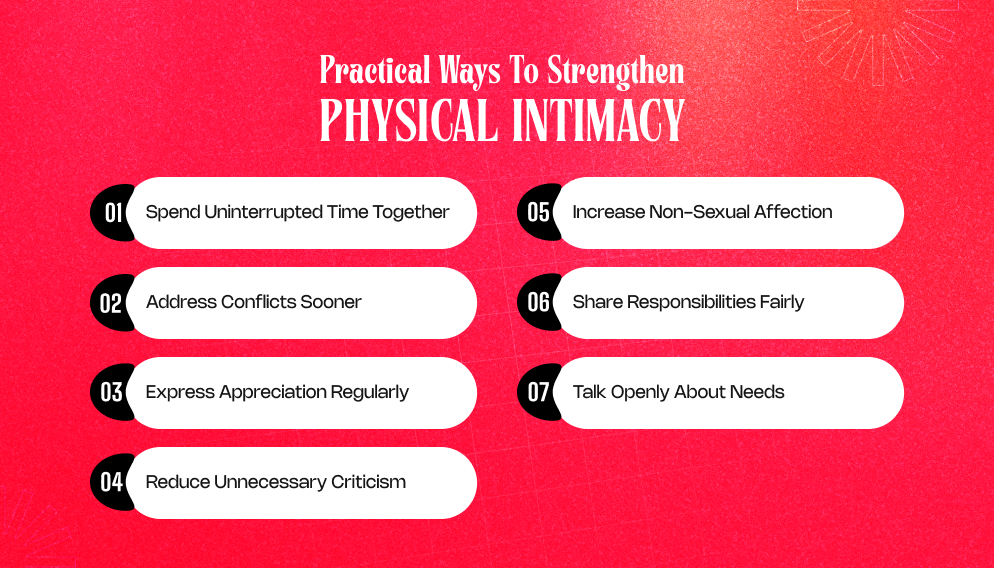
Improving physical intimacy does not always require dramatic changes. In fact, small actions often create the biggest impact over time.
So, here are a few practical starting points, based on my experience – which is great since I’ve been dating someone for nearly a decade now.
| Action | Why It Helps |
| Spend uninterrupted time together | Creates opportunities for genuine connection |
| Address conflicts sooner | Prevents resentment from building |
| Express appreciation regularly | Helps both partners feel valued |
| Reduce unnecessary criticism | Creates emotional safety |
| Increase non-sexual affection | Strengthens physical connection without pressure |
| Share responsibilities fairly | Reduces frustration and emotional exhaustion |
| Talk openly about needs | Improves understanding and trust |
None of these actions is complicated – their power comes from consistency.
Physical intimacy is rarely an isolated relationship issue. More often, it reflects what is happening throughout the rest of the partnership.
When people feel emotionally safe, appreciated, respected, and connected, physical closeness tends to develop more naturally.
However, when resentment, stress, neglect, or poor communication take over, intimacy often suffers.
That is why improving physical intimacy usually starts outside the bedroom. It starts in conversations. It starts with daily habits.
Moreover, it starts in the way two people treat each other when there is no expectation of romance at all. In many relationships, the path back to physical closeness begins with rebuilding connection in the ordinary moments that happen long before bedtime.