I have been in a long-term relationship for more than seven years, which is a pretty long time to just date someone.
While we have literally no challenge stopping us from getting married, we didn’t want to get married too early into the relationship.
In fact, it took us only ten days to get into a relationship – one date followed by meeting every day, texting all the time, and finally a relationship at the end of ten days. At the time, it certainly felt too soon, and everyone made it very obvious that we are in for a shock.
Nobody took us seriously. 7 years later, we are going stronger than ever – and now, everyone calls us ‘end game.’ But we have never really followed society’s rules; we follow the rules we make as a couple (or sometimes I make them for the two of us!).
Having said so, we have had our fair share of ups and downs, considering we don’t live together – we have 15 kms between each other and two completely opposite careers. I am a writer, and he is a mountaineer. So, our schedules hardly match.
Things were really hard a few years ago. But a few years ago, we made a conscious choice to use technology in a way that makes our relationship better – meet apps for couples that can make life easier and your relationship better.
Yep, the success of our relationship largely depends on these apps for couples – and if you have been struggling with making it work, you need these apps! And with my help, you can make things better, trust me!
Stay tuned!
Apps For Couples That Make Life Together Easier (A Quick Summary):
Before I dive into the details, here’s a quick summary for you to glance through.
| App | Best For | Key Strength | Potential Drawback |
| Between | Long-distance couples | Private space for messages, photos, and memories | Limited usefulness if you mainly use standard messaging apps |
| Paired | Communication and relationship growth | Daily questions, quizzes, and conversation prompts | Requires consistent participation from both partners |
| Rave | Long-distance date nights | Real-time movie and video watching | Focused on entertainment rather than relationship management |
| Google Calendar | Scheduling and planning | Easy shared calendars and reminders | Doesn’t include relationship-specific features |
| Cozi | Household management | Combines calendars, lists, and reminders | Interface may feel more family-oriented than couple-focused |
| TimeTree | Coordinating busy schedules | Event comments and collaborative planning | Less useful if both partners already use another calendar system |
| Agapé | Meaningful conversations | Thoughtful prompts and relationship check-ins | Not designed for scheduling or task management |
| Lasting | Relationship education | Guided sessions based on counseling principles | Some content requires a subscription |
| YNAB | Serious financial planning | Goal-focused budgeting and spending control | The learning curve can be steep initially |
| Monarch Money | Complete financial visibility | Tracks accounts, investments, and goals in one place | Premium pricing compared to some alternatives |
| Honeydue | Shared finances | Built specifically for couples with flexible privacy controls | Fewer advanced budgeting features than dedicated budgeting apps |
| Goodbudget | Simple budgeting | Easy visual budgeting system | Less automated than modern finance apps |
| Todoist | Shared responsibilities | Excellent for chores and to-do lists | Not relationship-focused |
| AnyList | Grocery and shopping planning | Fast, simple shared lists | Limited beyond shopping and meal planning |
Key Observations:
1. Best overall for couples: Paired
2. Best for long-distance relationships: Between
3. Best for scheduling: Google Calendar
4. Best for household management: Cozi
5. Best for budgeting: YNAB
6. Best for shared finances: Honeydue
7. Best for relationship growth: Lasting
8. Best free option: Google Calendar
| We Tested These Apps Based On: Ease of use. Couple-focused features.Privacy and value.Cross-platform compatibility. Every day practicality. |
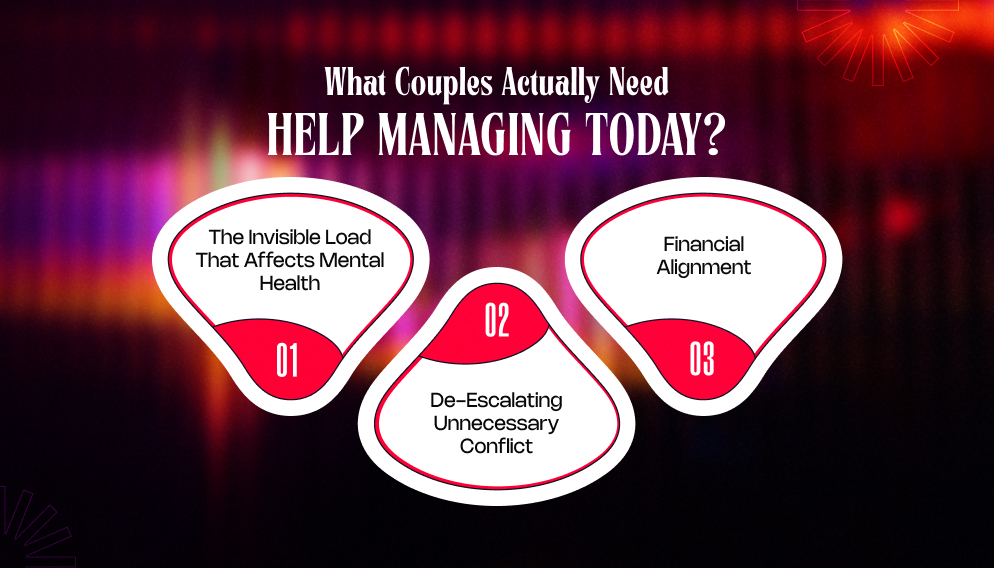
What Couples Actually Need Help Managing Today?
To be fair, the entire dating landscape has undergone a complete Renaissance – and with such evolving dynamics of romantic equations, things will obviously change between couples, too.
Much like things have changed in the dating scene, relationships don’t operate in the same way any longer – remember my example in the introduction about how my boyfriend and I have been dating for so long, minus the chaos, thanks to technology, trust, and lots of love!
On that note, it is essential that I highlight what couples actually need technology for in 2026 – where can technology really step in to save the day?
1. The Invisible Load That Affects Mental Health:
It could be something as simple as tracking important dates in your relationship or something a little more useful, like weekly groceries. But it’s the kind of thing we tend to forget – it might be small, but it creates a deep sense of resentment.
How could he forget our anniversary? Or how could he forget it was his turn to take the trash out? Of course, he didn’t plan it out intentionally – he forgot, and a busy worklife and subsequent stress can make it worse.
And that is precisely where technology can step in to help – shared calendars and to-do apps can solve this problem within weeks.
2. De-Escalating Unnecessary Conflict:
Work stress can easily lower your tolerance – just because you have had a taxing week at work, your patience might run thin.
So, even if you didn’t mean you just told him to get lost over something simple like an unanswered message. And it almost always leads to conflict that could have been avoided if you weren’t so bogged down with stress and exhaustion.
Just with the right changes in your routine, this can be solved!
For example, every time I start getting mad over something small, I consciously breathe while counting to 30. I only respond after I’ve counted to 30, and it has really helped me calm down since I’ve been struggling with easy anger for years.
3. Financial Alignment:
Needless to say, the economy is at an all-time low, and cash flow is significantly impacted. I’m working ten times harder just to make the same money I was making a few years ago. And it’s the same for everyone.
As two very independent people, financial alignment is perhaps the most essential goal of our relationships. And thankfully, we have heavily relied on technology for years to match our financial goals.
Moreover, we depend on tech for everything money-related – our expenses, savings, and budgeting.
If you are in a long-term relationship, financial alignment via technology is a must – and the sooner you understand, the better for you!
Best Apps For Long-Distance Couples:
Personally, I hate being in long-distance relationships. But it’s not some prejudice I have been nursing for years. Between 2014 and 2016, I was in a long-distance relationship.
Everything was great, but the distance won at the end – and we? Two strangers who went their separate ways. And I would never want that to happen to anyone.
As a result, if you are in a long-distance relationship and you are serious about making it work, you need these apps.
1. Between:
Best for: Couples who want a private space dedicated entirely to their relationship.
Between functions as a shared digital space where partners can exchange messages, photos, videos, and voice notes without the distractions of traditional social media platforms. Many couples use it as a relationship journal, storing memories and conversations in one place.
2. Paired:
Best for: Couples who want to strengthen communication and learn more about each other.
Paired uses daily questions, quizzes, and guided conversation prompts to encourage meaningful discussions. The app helps couples uncover new insights about each other’s thoughts, preferences, and relationship expectations.
3. Rave:
Best for: Couples who miss sharing everyday experiences together.
Rave allows partners to watch movies, videos, and other content simultaneously while chatting in real time. It recreates the feeling of enjoying entertainment together, even when separated by distance.
Best Shared Calendar Apps For Couples:
If someone had told me I needed shared calendar apps for the sustainability of my relationship a few years ago, then I would have laughed out loud.
And especially for most of us old enough to have a job before the pandemic can remember how technology wasn’t always the answer to issues like scheduling conflicts and anniversary reminders.
But with time passing, I’m getting busier than ever – I can’t function without a to-do list app and shared calendar. And while you can use apps that might charge you a small fee, you can always opt for Google Calendar – it’s largely free, easy to use, and always the best option!
4. Google Calendar:
Best for: Couples who want a simple, reliable way to stay on top of schedules.
Google Calendar remains one of the easiest tools for managing a shared life. Couples can create calendars for date nights, vacations, bills, family events, work commitments, and important reminders. Since many people already use Google services, getting started usually takes only a few minutes.
5. TimeTree:
Best for: Couples who need more collaboration around their schedules.
TimeTree goes beyond basic calendar sharing. Partners can comment on events, discuss plans, and make updates directly within the calendar. Instead of jumping between messaging apps and scheduling tools, conversations stay connected to the events themselves.
6. Cozi:
Best for: Couples managing a household together.
Cozi combines a shared calendar with shopping lists, reminders, and to-do lists, making it useful for couples who want more than scheduling alone. It works particularly well for partners juggling errands, appointments, grocery runs, and household responsibilities.
Best Budgeting Apps For Couples
Honestly, when I was 25, I would have never been able to talk about this, let alone write about it.
But the more time has passed, I have realized something simple – fighting about money leaves this bitter aftertaste inside my mouth that makes me feel really yucky.
Maybe it’s the privilege of growing up with money, maybe it’s the relationship dynamic I saw at home. But whatever it is, fighting about money is an all-time low for me.
Having said that, money fights are very common, and they will happen, especially if there is no age difference, as with my partner.
Also, considering I’m an only child and so he is, our issues are very similar. We are independent and hate help – but if help isn’t offered, it hurts us. Sounds complex, right? Yes, that’s why we needed these apps to save our relationship from unnecessary money fights.
7. YNAB:
Best for: Couples who want complete control over their finances.
YNAB follows a proactive budgeting approach by encouraging users to assign every dollar a specific purpose before spending it. Instead of tracking where money went, couples plan where it should go first.
8. Monarch Money:
Best for: Couples who want a complete view of their financial life.
Monarch Money brings together bank accounts, investments, spending habits, budgets, and financial goals into a single dashboard. It helps couples make decisions based on real financial data rather than assumptions.
9. Honeydue:
Best for: Couples managing shared finances while maintaining flexibility.
Unlike many budgeting tools, Honeydue was built specifically for couples. Partners can track spending, monitor bills, and coordinate financial responsibilities while choosing how much information they want to share with each other.
10. Goodbudget:
Best for: Couples who prefer a simple and visual budgeting system.
Goodbudget modernizes the traditional envelope-budgeting method by allowing couples to allocate money into spending categories before the month begins. The visual approach makes it easy to see where money is being spent and where adjustments may be needed.
Best Communication And Relationship Apps:
Communication has always been my strong suit.
But unfortunately, my man doesn’t talk much – while it has always been a great compatibility factor considering I talk a lot, and he hardly talks, the truth is, after a point, I would get pissed.
I wanted him to share his fears, his problems with me, and he just wouldn’t for the longest time.
Needless to say, with the right apps, he has finally opened up – and sometimes it feels like the Honeymoon phase. Now, we have fixed schedules when we talk – it’s a part of our routine now.
11. Paired:
Best for: Couples who want to strengthen communication and build better relationship habits.
Paired offers daily questions, quizzes, and guided prompts designed to spark meaningful conversations. Instead of falling into the routine of discussing only work, errands, and schedules, couples can explore topics that encourage deeper understanding and emotional connection.
12. Agapé:
Best for: Couples looking for more meaningful conversations without feeling like they’re doing relationship homework.
Agapé focuses on thoughtful prompts that encourage partners to discuss values, goals, experiences, and emotions. The questions range from lighthearted topics to deeper conversations, making it easier for couples to connect on a regular basis.
13. Lasting:
Best for: Couples interested in improving their relationship through guided learning and self-reflection.
Lasting uses concepts commonly found in relationship counseling to help couples work through topics such as communication, trust, conflict resolution, intimacy, and emotional connection. Many couples use it proactively rather than waiting for problems to arise.
Apps That Help Couples Manage A Household
While this is not applicable for me, you will be surprised to know my parents, who have been married for three decades, use Todoist religiously to manage their household.
Of course, I suggested the idea to them a couple of years back, thanks to their constant bickering and annoying fights over shared duties and responsibilities. For the first time, they took my advice and installed Todoist.
Needless to say, they are doing an effective job at managing their home. But most importantly, there are no fights about this anymore – ah, the peace!
14. Todoist:
Best for: Couples who want a clear system for managing shared responsibilities.
Todoist turns household tasks into organized, trackable projects. Partners can assign chores, set deadlines, create recurring tasks, and receive reminders when something needs attention. It’s particularly useful for couples who want to divide responsibilities more fairly and avoid constantly reminding each other about unfinished tasks.
15. AnyList:
Best for: Couples who frequently shop, cook, and plan meals together.
AnyList simplifies grocery shopping by allowing partners to create and update shared shopping lists in real time. Items added by one person instantly appear for the other, reducing duplicate purchases and forgotten essentials. The app also includes meal-planning features for households that like to organize meals in advance.
16. Cozi:
Best for: Couples looking for an all-in-one household organization tool.
Cozi combines shared calendars, shopping lists, reminders, and to-do lists within a single platform. Rather than managing household responsibilities across multiple apps, couples can keep schedules, errands, appointments, and tasks organized in one place.
17. Google Keep:
Best for: Couples who prefer a simple and flexible note-sharing solution.
Google Keep allows partners to create shared notes, checklists, reminders, and quick ideas that update instantly. While it’s not specifically designed for couples, its simplicity makes it useful for everything from grocery lists to vacation planning.
Apps For Couples: How To Choose The Right App For Your Relationship?
Of course, this decision entirely rests upon you and your partner.
However, here’s my two cents on choosing the right app – I’ve used a table since it helps me decide faster, and I hope it does the same for you.
| If Your Biggest Problem Is | Use |
| Distance | Between |
| Scheduling | Google Calendar |
| Budgeting | YNAB |
| Communication | Paired |
| Household Management | Cozi |
| Relationship Growth | Lasting |
Privacy Considerations Before Using Couple Apps:
Couple-focused apps often store some of the most personal information people share.
Conversations, photos, financial details, schedules, reminders, and future plans can all be housed within a single platform.
As a result, before downloading any app, it’s worth taking a closer look at how your data is collected, stored, and protected.
- Always review privacy policies.
- Understand what information you are sharing.
- Protect your financial information as much as possible.
- Discuss privacy expectations as a couple.
- Use strong passwords and ensure your account is secure.
Remember, convenience is great, but it should never come at the cost of your privacy.
Do Couples Actually Need Dedicated Relationship Apps?
Turning to an app to improve your relationship is not a very novel idea.
In fact, over half of individuals under 30 reported using dating apps, while 1 in every 5 individuals said that they met their long-term partner through an app. (Source: Pew Research)
In an organic expansion of dating tech, apps for growing and nourishing our relationships have made it into your phones as well.
And while these apps are great for tracking your finances, shared activities, and communication, you cannot use them as some kind of a substitute for therapy.
While you can install an app to ensure you guys plan more dates every month and spend time together, you can’t install an app for dealing with this emotional infidelity – in that case, you need actual therapy, if you still want to make it work.
Moreover, these apps cannot exactly replace what a relationship counselor brings to your relationship. But they can definitely boost your therapeutic work.
For instance, these apps can help you develop your communication skills and keep difficult conversations going.
Also, for me, it has always been about balance – I genuinely pick my battles. See, there are some situations where an app can’t help you in any way, like infidelity or abusive behavioral patterns. But if your relationship is in the maintenance mode and both of you are committed to improving things – and spicing it up – then apps can definitely help you out!