

You do not always notice resentment when it begins.
For me, it often builds when my partner fails to acknowledge my feelings – just because he doesn’t think it’s a big deal, he thinks my reaction will be similar to his.
And for the longest time, I would say, ‘it’s fine’ when things weren’t fine at all – what happened was I developed a lot of resentment in my heart. While it felt easy to hide it from my partner initially, it became really weird after some time.
Everything started triggering me – I was a ticking time bomb waiting to fall on my boyfriend’s head – until one day he sat me down and said, ‘Spit it out.’
And thank god, he finally got it.
But it’s important to understand that not everyone will ask you to spit it out. So, the resentment builds. Then something small happens.
Your partner forgets to do one thing. They ask you for a favor. Or they leave something incomplete. Suddenly, you are super mad – everything feels bigger than what the reality demands.
And that is your resentment tearing free from within you – out on display for your partner to see.
Resentment rarely starts with one bad day. It usually grows around a pattern that never gets properly addressed.
Also, the strangest thing about resentment is you can actually love your partner to death and still resent them. I could appreciate all the good things about my relationship and still resent my partner for not acknowledging my feelings.
Today, I am going to discuss why it is important to understand what created feelings of resentment in your heart – and break down how you can stop feeling this way.
Stay tuned.
What Is Resentment In A Relationship?

Resentment is a lingering feeling of anger, hurt, or bitterness toward someone because you believe they have treated you unfairly or failed to meet an important need.
In a relationship, resentment often develops over time.
It is possible that you feel you are giving more in the relationship while your partner is barely doing anything. Also, you can feel unappreciated, ignored, or even taken for granted.
Sometimes the problem is obvious. But in most cases, resentment usually grows around problems that were never discussed with clarity.
For instance, it is possible that you expect your partner to be more attentive towards you when you feel burnt out, stressed, or overwhelmed. But they do not.
You take on more work instead of asking for help. Then you become frustrated because they seem perfectly comfortable while you struggle.
Your partner may not understand what change. But you do – you have been keeping track of every time you felt unsupported.
And this is precisely why it is so difficult to move on from such feelings. At the end of the day, the person who feels this way usually reacts from a place of long emotional history.
In contrast, the other person is only reacting to the most recent disagreement.
Resentment Vs Anger:
To be honest, anger and resentment share close ties – they are related for sure. But are they the same things? Not really.
So, anger is often a reaction to something that has already happened; resentment often carries what happened forward.
For example, I get mad at my boyfriend over several things – like when he forgets to drop me a text after reaching work. But when he calls me back and explains why, my anger disappears, and I feel better.
But resentment is different – it lingers in the nooks and corners of your heart until it grows into a big cloud ready to burst.
And that is the primary difference between the two emotions. Resentment usually appears like some sort of unresolved pattern rather than some isolated incident.
The Resentment Loop: How It Builds Without You Realizing?
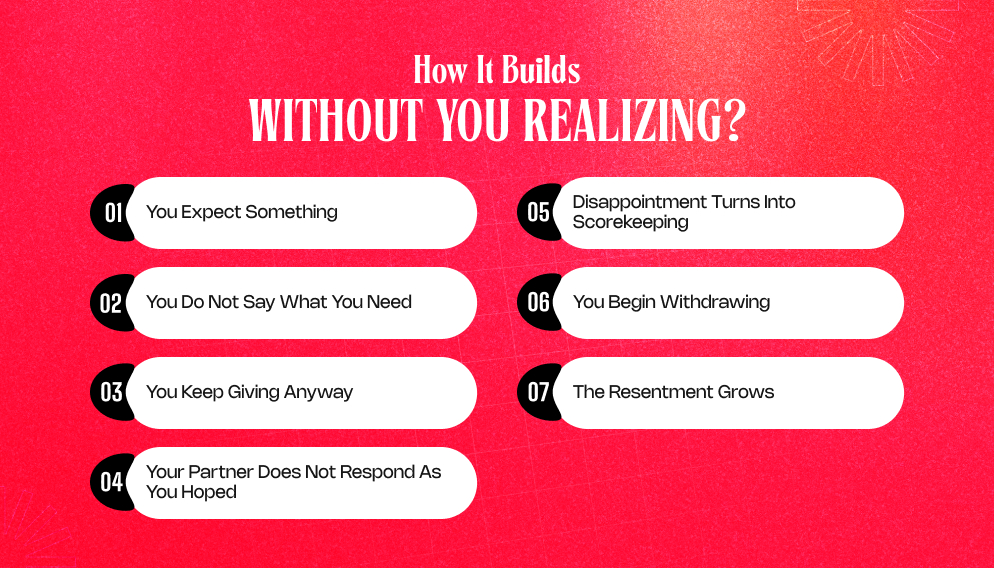
In my personal life, I’ve seen that the easiest way to understand how resentment builds in a relationship is to figure out what is causing it.
For me, the pattern often looks like this: Expectation → Silence → Overgiving → Disappointment → Scorekeeping → Withdrawal → Resentment
To simplify matters, here’s a breakdown of how resentment develops without you even realizing it.
1. You Expect Something:
It is normal to expect your partner to notice when you need help. You expect them to remember something important. Or you expect them to just acknowledge your feelings.
And these expectations aren’t always unacceptable or illogical.
2. You Do Not Say What You Need:
Instead of asking, you wait – you start thinking that your partner will understand even if you don’t tell them what’s bothering you.
You are still acting from a place of expectations – but this one’s a little unreasonable. But in most cases, we fail to notice it.
3. You Keep Giving Anyway:
You do the extra work. And you make the compromises. Also, you forgive the mistake – you pick up the responsibility again.
Why? Because it feels easier to do this than have a conversation with your partner.
4. Your Partner Does Not Respond As You Hoped:
Honestly, the problem begins here – your partner doesn’t even realize that they have failed to meet your expectation.
So, you see no change – your partner is behaving in the same way with you. But you notice.
5. Disappointment Turns Into Scorekeeping:
Now you start remembering everything – You remember the chores you handled. You remember the plans you changed. Also, all the times they failed to do the same for you.
Your relationship suddenly becomes a scorecard that tracks who did what and, most importantly, who didn’t.
6. You Begin Withdrawing:
You become less affectionate. And you stop offering help as freely. Also, you become quieter or, in some cases, impatient and sarcastic.
Of course, your partner will notice this shift. But the issue is they will not understand why it is happening in the first place.
7. The Resentment Grows:
Now you feel misunderstood on top of everything else. You think about how much you have done for your partner, and he still fails to see it.
However, your partner thinks, why are you so mad at them suddenly – where is all this coming from?
Do you see what’s happening here? Both of you have moved from the actual issue – and that is the resentment loop. Unless one of you breaks it, the same things will keep on repeating, and you will keep running in circles for months or even years.
Why Do We Resent People We Love?
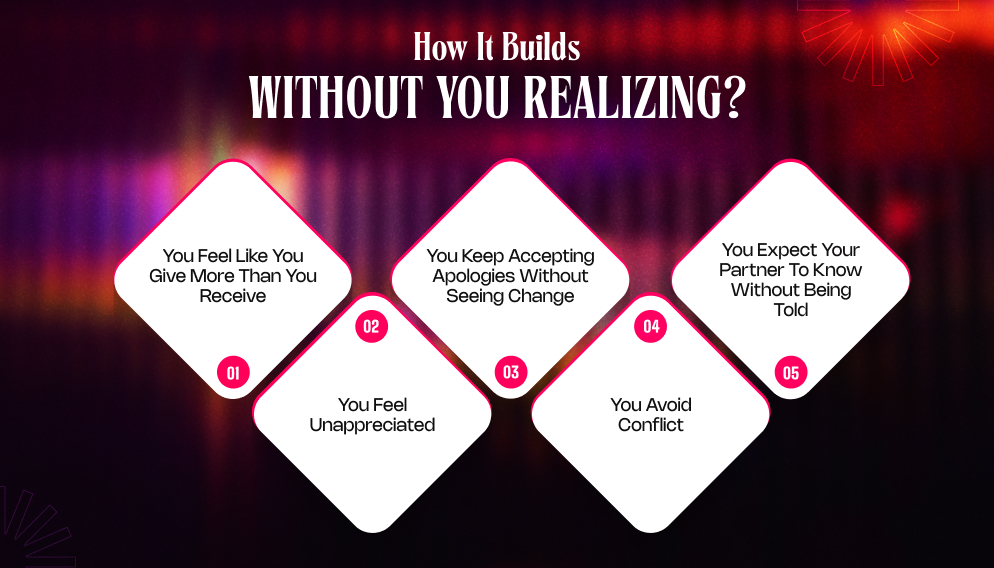
Resentment can feel confusing because love does not disappear when resentment appears. You may still care deeply about your partner. You may enjoy your life together.
Also, you may even know that your partner is a good person. But something about the relationship still hurts.
Frankly, there’s more than one thing that creates conflict – even if you love someone to death. To simplify why we only resent people we deeply love, here’s a breakdown.
- You Feel Like You Give More Than You Receive:
Of course, relationships aren’t perfect – and every day is not going to be the same for your relationship. One person may do more during a stressful period. The other may carry more responsibility later.
The problem starts when an imbalance becomes the normal arrangement. You may begin feeling like the person who always adjusts.
You make the plans, remember the appointments, handle the difficult conversations, and support your partner when they are struggling.
Then you realize you do not feel supported in return. The resentment may not come from doing these things. It may come from feeling that your effort has become expected rather than appreciated.
- You Feel Unappreciated:
Appreciation is not only about hearing “thank you.” You may want your partner to notice the effort behind what you do.
When that does not happen, ordinary responsibilities can start feeling heavy – You make dinner. You clean the kitchen. Also, you remember something your partner mentioned weeks ago.
Nothing seems to happen in return. Eventually, you may think, “Why should I keep trying when nobody seems to care?”
- You Keep Accepting Apologies Without Seeing Change:
An apology can matter.
But an apology does not automatically repair a repeated pattern. If your partner keeps doing the same thing, eventually “I’m sorry” may stop providing comfort.
You may start thinking, “You are sorry every time. But nothing changes.” That is where resentment can become deeper than the original hurt.
- You Avoid Conflict:
Some people would rather stay quiet than start an argument. That can work for small issues. But it rarely works when the same problem keeps happening.
You swallow the comment. Then you let another thing go. Then another. Eventually, the issue becomes much larger than it was at the beginning.
Silence can prevent a difficult conversation today. It can also create a much harder conversation six months later.
- You Expect Your Partner To Know Without Being Told:
You may think, “If they really knew me, they would understand.” But your partner cannot always know what you need.
Of course, he will notice that something is bothering you – that’s only normal. But he will not know why until you choose to come out clean about your feelings.
That does not mean you should have to explain every emotion. It does mean that unspoken expectations can become unfair tests.
10 Signs You May Be Resenting Your Partner:
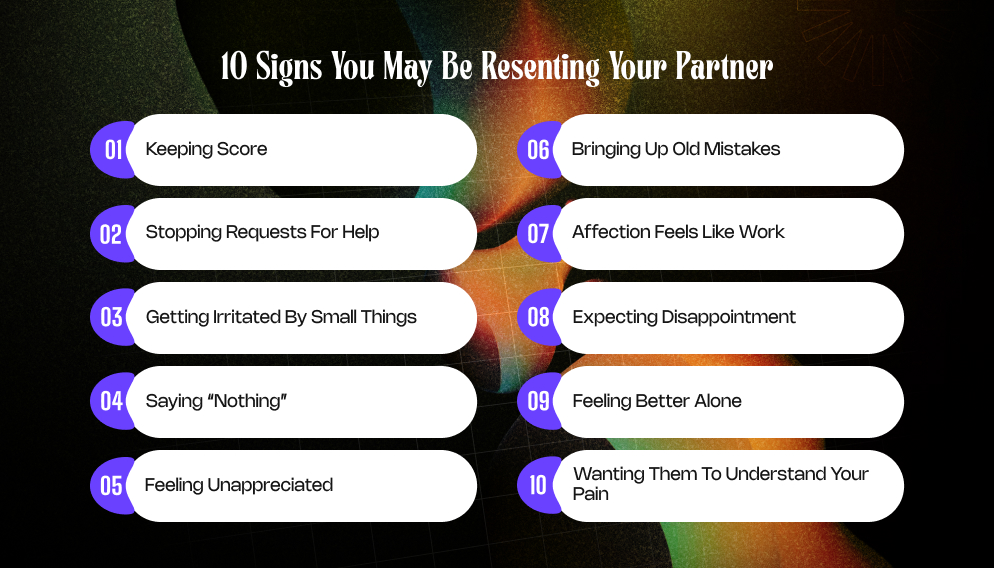
Resentment does not always look like anger. Sometimes it looks like distance. Sometimes it looks like indifference.
And sometimes it looks like constantly feeling irritated by someone you used to enjoy being around.
So, I thought it would be only appropriate to highlight the tops signs that indicate you might be resenting your partner.
| Sign | What It Looks Like |
| Keeping score | You remember what you give and what they don’t. |
| Stopping requests for help | You do everything yourself, then feel resentful. |
| Getting irritated by small things | Even simple requests start feeling like burdens. |
| Saying “nothing” | You hide your feelings and hope they notice. |
| Feeling unappreciated | “Thank you” no longer feels like enough. |
| Bringing up old mistakes | Past problems keep entering new arguments. |
| Affection feels like work | You show affection because you feel obligated. |
| Expecting disappointment | You assume promises will eventually be broken. |
| Feeling better alone | Being away from your partner feels easier. |
| Wanting them to understand your pain | You want them to experience what you’ve been carrying. |
The 3 Questions Behind Resentment:
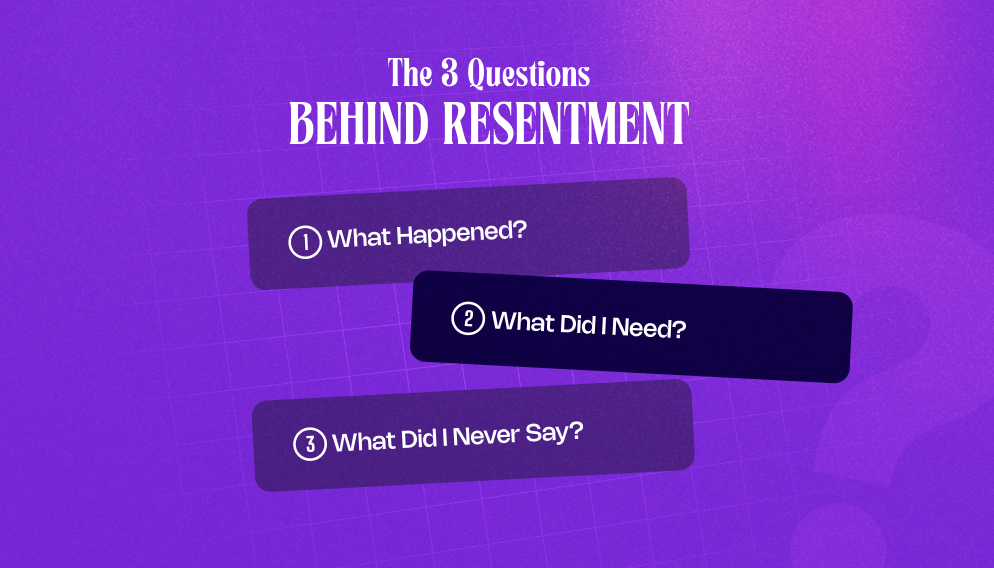
When you feel resentful, it is tempting to ask: “How do I stop feeling this way?” But honestly, you should start somewhere else – Ask yourself three questions.
1. What Happened?
Be specific. Do not start with: “My partner never cares about me.”
Instead, start with what actually happened – Did they repeatedly leave household responsibilities to you? Did they break a promise? Or did they dismiss something important?
Identify the event or pattern.
2. What Did I Need?
Maybe you needed help. Maybe you wanted affection. Or maybe you needed your partner to respect a boundary.
Knowing the need behind the resentment can make the problem much easier to discuss.
3. What Did I Never Say?
This is often the hardest question.
Maybe you expected your partner to notice. Maybe you agreed to something you did not want. Or maybe you kept forgiving without saying what needed to change.
Your resentment may involve both what your partner did and what you never communicated. B
However, that does not make the resentment invalid. It gives you another part of the problem to address.
How To Talk To Your Partner About Resentment?

Telling someone, “I resent you,” may be honest. But it may not be the most useful way to begin.
Instead, explain the pattern. There’s no point accusing your partner of never helping you or understanding your feelings, or something else for that matter.
But if you sit him down and really talk to him – like give him the context and come out clean about everything that’s bothering you – things might change.
At least, you will know you did your best – if he doesn’t do anything even after you talk to him maturely, then you know you can end the relationship and not feel guilty about it.
Because love can never be enough – just because I love my boyfriend, it doesn’t mean I will be fine with him not respecting my boundaries.
Remember the purpose behind talking with your partner is to solve the problem – the point isn’t to accuse him and make him feel guilty.
Rather, the point is to communicate what’s bothering you and what has to change in your relationship. That way, your partner will have something specific to think about and even respond to, if he feels like it.
Can Resentment Be Repaired? How To Let Go Of Resentment?
Yes, it is possible.
However, it is essential to point out that all the resentment in your heart is not going to disappear just because you want to move on – and the same is applicable to your partner.
In my experience, healing and rebuilding depend on three things:
- Recognition.
- Change.
- Time.
For a better understanding, I’ve discussed these three aspects in detail below.
- Recognition:
The hurt needs to be acknowledged – Not dismissed. Not explained away. And definitely not turned into an argument about who suffered more.
Also, if your partner has hurt you, then he has to understand what hurt you and why it matters.
- Change
This is where many couples get stuck – One person apologizes. The other person forgives them. Then the same behavior happens again.
Eventually, the apology loses its meaning. Repair requires some evidence that the pattern can actually change.
An apology addresses what happened. But changed behavior addresses what keeps happening.
- Time:
Even when someone changes, resentment may not disappear immediately.
If you spent months feeling ignored, you may not suddenly feel secure after one good conversation.
Give the relationship time to build a different pattern. Trust grows through repeated experiences.
How To Stop Resentment From Building Again?
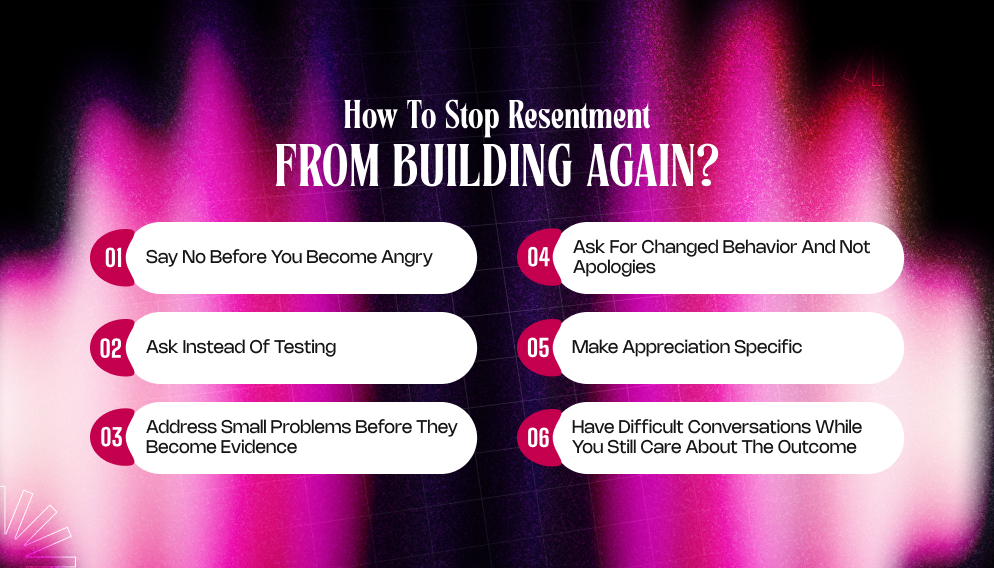
Repairing resentment is only part of the work. Couples also need to prevent the same pattern from returning.
1. Say No Before You Become Angry:
If you agree to everything and resent it later, the problem may begin with the agreement. A healthy “no” is usually better than an angry “yes.”
2. Ask Instead Of Testing:
Do not secretly test whether your partner will notice what you need. Tell them: You deserve a partner who listens. They also deserve a clear opportunity to respond.
3. Address Small Problems Before They Become Evidence:
One forgotten chore may not matter. Fifty forgotten chores probably will. So, deal with patterns before every new mistake becomes proof that your partner does not care.
4. Ask For Changed Behavior And Not Apologies:
If the same issue keeps happening, another apology may not be enough. Explain what you need to see change. Then pay attention to whether it actually changes.
5. Make Appreciation Specific:
Instead of saying only “thanks,” tell your partner what you noticed – “I really appreciated you handling dinner tonight. I was exhausted.”
Also, specific appreciation makes effort visible.
6. Have Difficult Conversations While You Still Care About The Outcome:
This may be the most important habit of all. Do not wait until you are emotionally finished with the problem. Talk while you still want something to change.
What Is Your Resentment Trying To Tell You?
Resentment is uncomfortable.
But it can also be revealing. It may be telling you that you need more help. It may be telling you that a boundary has been crossed.
Also, it may be telling you that you have been avoiding a difficult conversation. Or it may be telling you that the relationship has developed an imbalance that cannot continue.
The answer is not always to forgive faster.
Sometimes you need to speak. Sometimes your partner needs to change. And sometimes you need to accept that love alone cannot make an unhealthy pattern disappear.
The first step is to stop treating resentment as one big feeling and look underneath it.
- What happened?
- What did you need?
- Also, what did you never say?
Those three questions can tell you a lot about where the resentment came from and what needs to happen next.
Because resentment rarely appears out of nowhere – It usually grows in the space between what we give, what we expect, and what we never say.