

As a mountaineer’s girlfriend, alpine divorce is a scary dating trend. I mean, I was prepared for a lot of dating trends, but this one?
Not exactly.
A couple of years ago, I went on a challenging trek. So, I do this often – I travel with my boyfriend and try out everything he does at least once, be it lead climbing, a tough trek that lasted 11 days, or even slacklining for that matter.
I have trekked before, but I wasn’t ready for this kind of experience. While it has remained one of my favorite trips over the years, it was also the most challenging adventure I had experienced at the time.
For context, we traveled to Goechala Pass in West Sikkim, located 16,000 feet above sea level. I distinctly remember how difficult things got – we were returning, and I was alone with my boyfriend for the entire last stretch.
I got my periods and I was super pissed – my hormones were everywhere, I had severe cramps, and it was too cold.
Without even realizing what was happening, I kept fighting with my boyfriend, and he was walking ahead of me – not even for a second did he consider abandoning me and walking away.
If he had done that, I might not have been sitting here writing about it.
Naturally, I was devastated to find out that there are women who actually go through it – and an alpine divorce is a real thing.
It made me think about so many things – how mountains bring out the real you, how challenging times expose the truth about a relationship, how comfortable living can never reveal your partner’s real self.
Today, I’ll discuss Alpine divorce with you – and primarily break down why such situations reveal the truth about most relationships.
Stay tuned.
What Is Alpine Divorce?
People on the internet, specifically TikTok and Instagram, have been using ‘alpine divorce’ as a phrase to discuss what @EverAfterIya posted on 18th February (on TikTok), earlier this year.
So, for the ones who don’t know, this post was able to garner over 19 million views – it featured one woman stranded on a rocky trail. She was weeping while calling the day, “The worst Saturday of my life.”
Moreover, the video came with a text overlaying which stated, “POV: you go on a hike with him in the mountains, but he leaves you alone by yourself, and you realize he never liked you to begin with.”
Yeah, abandoning your partner during a hike sounds like a horrible thing to do.
Originally, the term first appeared in a short story, called ‘Alpine Divorce,’ that Robert Barr wrote in 1893.
Things get much darker when you look at the story’s origins. In Barr’s tale, a man travels through the Swiss Alps with his wife while secretly planning to kill her.
Naturally, this term has become an alias for abandoning your partner in an outdoor remote setting.
This generally leads to the relationship ending – I mean, who would want to be with such a person!
Moreover, once @EverAfterlya posted about this, it prompted others to come forward with their experiences. One person even commented, “There’s a name for this, alpine divorce. This happens frequently enough that there’s a support group for survivors.”
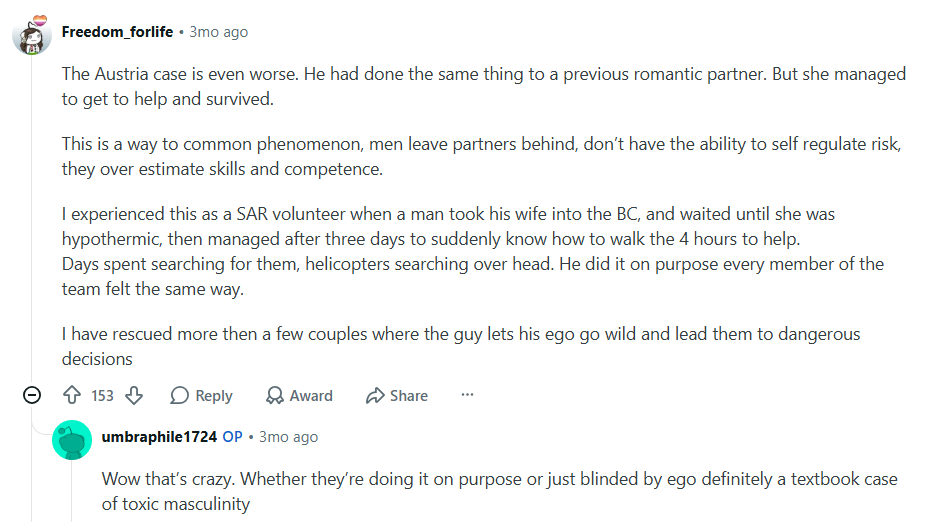
To make matters worse, mountaineer Thomas Plamberger abandoned his girlfriend, Kerstin Gurtner, on Grossglockner mountain, the highest peak in Austria.
Gurtner literally froze to an unfortunate death, and Plamberger was found to be grossly negligent, which led to his girlfriend’s death. (source: BBC News)
Why Is The Hiking Community Reacting So Strongly Against It?
I’ve been traveling to the mountains for more than 7 years, roughly the same amount of time as my relationship.
The mountaineering community is rooted in collaboration – there’s no competition, there’s only collaboration.
Weather changes randomly, landslides can happen at any time, and you can get stranded on an odd route for hours. During tough times, who do you count on? The people you are traveling with.
For even the smallest treks, I’ve seen how important it is to get along with everyone – you can’t fight with people. You get along with them.
Naturally, when you are going alone with your partner, and you have more expertise, the accountability lies with you.
To be honest, it is an unwritten rule – the group doesn’t move at the pace of the fastest. Rather, the group’s pace depends on who is the slowest.
I remember my friend Esha was 2 hours behind us, but 16 of us waited for her to reach the spot before we started for the next stop.
The point is not to hold hands and walk but rather to ensure nobody is left behind.
When people hear stories about Alpine divorce, they’re not just reacting to poor relationship behavior.
They’re reacting to behavior that many consider bad outdoor etiquette and, in some situations, a genuine safety concern.
The Part Nobody Talks About:
Most articles stop there – I was horribly disappointed to find nothing on the internet except endless blogs that explain the term, share a few examples, and move on.
But the interesting question isn’t what Alpine divorce means. Instead, the interesting question is why the idea resonates so strongly.
After all, couples argue everywhere. Then, why has one specific type of argument captured so much attention?
The answer may have something to do with how hiking strips away the distractions that normally help smooth over relationship problems.
A dinner date can hide a lot. So can a weekend away. But a long hike? That’s different.
People get tired. They get uncomfortable. They become impatient. Plans change. Expectations collide with reality.
Suddenly, the qualities that make relationships work, communication, patience, empathy, and flexibility, become much more visible.
So do the qualities that make relationships difficult.
When A Partner Becomes A Competitor:
Read enough stories about Alpine divorce, and a common theme starts to emerge.
The issue is rarely speed. Instead, it’s a mindset.
One person views the experience as something they are doing with their partner. The other begins viewing it as something they are doing for themselves.
That shift changes everything.
Of course, he can be super fast yet still be a supportive partner. Moreover, why can’t a highly ambitious person still be part of a healthy relationship?
Problems usually appear when achievement becomes more important than connection.
The summit matters more than the person. The goal matters more than the experience. More importantly, the destination matters more than the partnership.
That’s when a hike starts revealing something deeper.

Related Article For You: Honeymoon Phase: How To Thrive After The Relationship Is Over?
What Alpine Divorce Can Teach Us About Relationships?
Honestly, I think you need to be a really evil person to do something like this – I mean, I can understand why you cheated, but why would you abandon me in a life-threatening relationship?
Moreover, I would not even consider leaving my enemy alone on a mountain slope. Naturally, leaving someone I love is out of the question.
Having said that, I feel perhaps the reason this trend has struck such a chord is that it highlights a question every relationship eventually faces.
What happens when life becomes difficult? Not when everything is going well. Not when both people feel energized and optimistic.
What happens when one person is struggling? Do you slow down? Do you listen or even consider adjusting your expectations?
Or do you keep moving and expect the other person to figure it out on their own? Those questions matter on a mountain. And they matter even more everywhere else.