
I have a married friend – he married his college sweetheart after dating for over a decade. And in such cases, it is usually expected that the relationship will run smoothly after marriage.
While the first year was smooth and romantic, things started going downhill soon after – for starters, he was constantly trapped between giving his wife time and attending to his high-demanding corporate role.
Of course, this was just an underlying issue that they were facing.
They thought bringing a child into the equation would make things better – turns out, that bringing the child itself was exhausting, straining the relationship further.
While pregnancy brought temporary joy, postpartum only made it worse – so much so that the couple stopped having sex.
No sex for two years – and that only led to two people living together with only one purpose: to raise a healthy child.
Of course, it’s a challenge to be trapped in a marriage when there’s nothing left except a child you love with your whole heart.
But that doesn’t change the fact that my friend loved his wife – they just didn’t know how to spice up a relationship anymore, especially because of the growing distance.
To be fair, he sought my advice, and after several long conversations, he was able to make things better – and currently, they are doing really well together.
I recently met the couple at an event, and you could just see how much things have changed. They were all over each other, and their daughter was growing up just fine in a happy home.
So, I came back home and decided to pen down how the problem isn’t boredom or exhaustion – hopefully, after reading this, you will be able to spice up a relationship that does feel distant.
Stay tuned.
Why Long-Term Relationships Lose Spark?
You know, we have this habit of assuming that relationships lose spark after a certain amount of time passes.
Once the Honeymoon phase is over, the mystery of not knowing someone closely disappears – the cracks begin to appear, and with it the fear, will this last?
Of course, how you deal with the cracks decides whether or not the relationship will progress – honestly, it depends on your reactions to how you handle this.
For me, I’ve always prioritized transparency – if something bothers me, I’ve addressed it with my partner because it is important for me to speak up about every issue out there.
And trust me, it works – if it has worked for me, it will work for you. Because when you keep things to yourself, you let your heart build resentment.
But when you speak up, you are giving yourself a fair shot – even if it doesn’t work out, you know you did what you could.
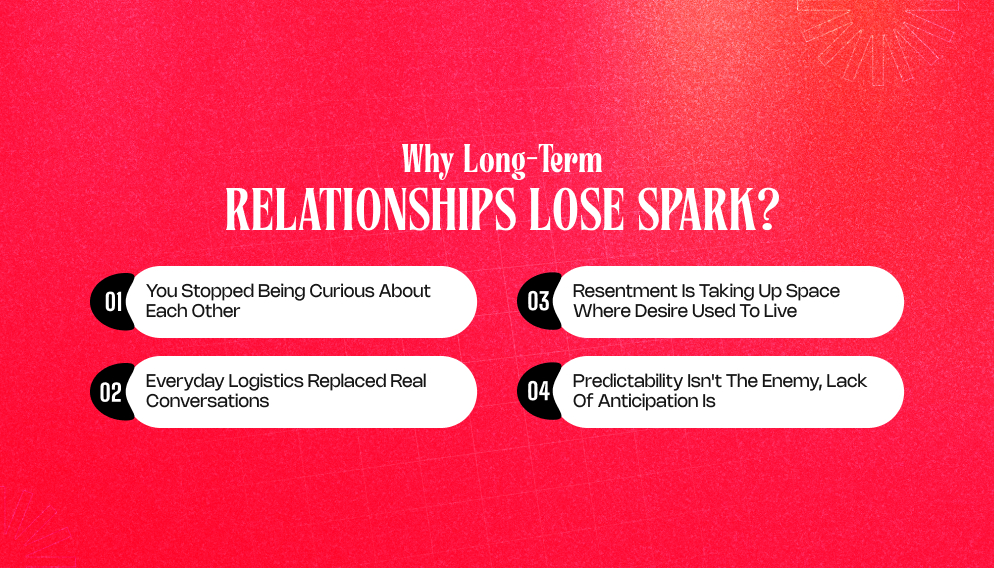
On that note, I’ve highlighted four primary reasons that contribute to the significant loss of spark in your relationship.
1. You Stopped Being Curious About Each Other:
A lot of couples stop asking real questions once they feel settled.
In the beginning, curiosity comes naturally. You want to know everything – What they think, what they fear, what excites them, and more importantly, what they want from life.
Then something changes.
Suddenly, you start assuming you already know.
You know how they order coffee. You know which movie they’ll pick. Also, you know what they usually say about work. So you stop asking.
The problem is that people keep changing. The partner you met five years ago is not the same person sitting across from you today.
Moreover, a new job can change priorities, a difficult year can change perspective, and personal success can create new ambitions.
Yet many couples continue relating to an older version of each other.
2. Everyday Logistics Replaced Real Conversations:
Listen to many long-term couples for a few minutes.
While you’ll hear plenty of communication, what you may not hear is conversation.
- Did you pay the bill?
- Can you pick up the kids?
- What should we have for dinner?
- Don’t forget the doctor’s appointment.
Of course, these discussions matter – life would be chaotic without them. But they don’t create a connection.
As a result, a relationship can run smoothly while intimacy quietly disappears in the background.
Everything gets done. The house functions and the schedules stay organized. But neither person really talks about what has been on their mind lately.
Also, they stop sharing ideas, worries, goals, and random thoughts. Eventually, they become excellent teammates.
They just stop feeling like close partners.
3. Resentment Is Taking Up Space Where Desire Used To Live:
When passion fades, many people assume they need more excitement. Sometimes they need fewer unresolved problems.
This is because resentment rarely arrives overnight. In fact, it grows from small frustrations that never get addressed.
While one person feels responsible for most of the household work, the other feels constantly criticized.
Moreover, one partner doesn’t feel heard. But the other feels emotionally ignored. None of these issues seems huge on its own.
However, together, they create distance.
As a result, desire struggles in that environment. It’s difficult to feel close to someone when frustration follows every interaction.
For instance, a weekend getaway might help temporarily. Or a date night might create a good evening. But unresolved resentment often follows couples home.
Until those frustrations are addressed, rebuilding intimacy becomes much harder.
4. Predictability Isn’t The Enemy, Lack Of Anticipation Is:
Routine gets blamed for almost everything.
But frankly speaking, routine was never the problem. I love routines, and not just me; most people enjoy routine.
They like familiar restaurants. They enjoy weekend traditions. Also, they appreciate stability. So, the real issue is having nothing to look forward to together. Think about the early stages of a relationship.
There is always something ahead – the next date, the next trip, the next milestone, or the next shared experience.
Anticipation creates excitement long before the event arrives. Many long-term couples lose that feeling.
Moreover, life becomes a cycle of responsibilities and obligations – it is all about work, home, sleep, and repeat.
Months pass without any shared project, goal, or adventure on the horizon. That doesn’t mean you need grand gestures.
Instead, think about how a planned road trip can work, or how learning a new skill together can work. Even renovating a room or training for a local event can create momentum.
People feel energized when they are moving toward something, and relationships are no different.
How To Spice Up A Relationship That Feels Distant?
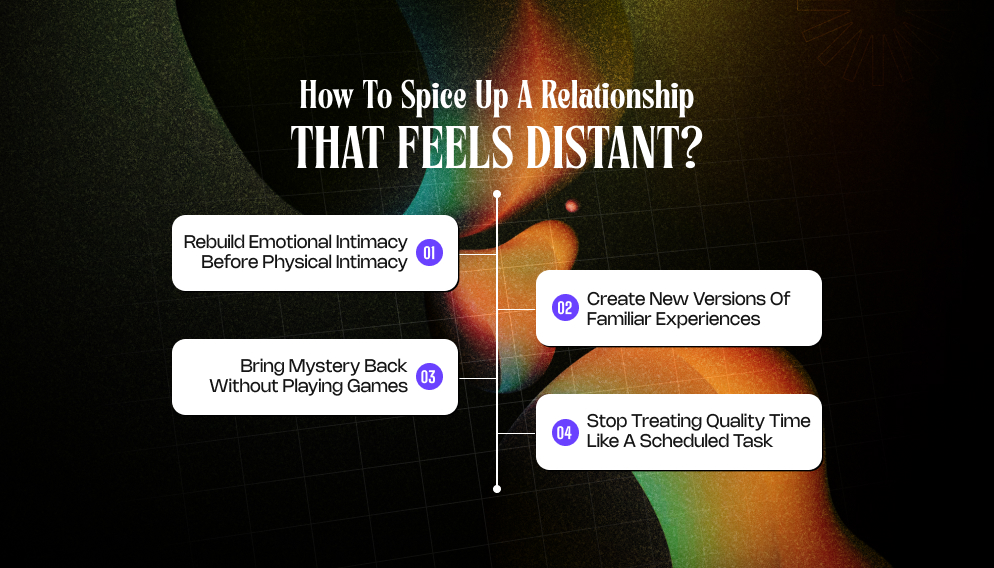
In this section, I’m not going to waste any time and just move to the solution – don’t know whether it will work for you.
But if it doesn’t, at least you will know this wasn’t meant for you, and you deserve someone better – someone who will love you and not make you wonder what you did wrong.
1. Rebuild Emotional Intimacy Before Physical Intimacy:
When couples talk about losing the spark, they often focus on physical intimacy. But physical distance is often the result of emotional distance.
It is difficult to feel close to someone when you do not feel understood by them, or valued by them, or even chosen by them.
Many people think emotional intimacy is about having more conversations. Sometimes it is. But plenty of couples talk every day and still feel alone in their relationship.
The deeper question is this: when something important happens in your life, does your partner genuinely care?
So, when you share a frustration, do they try to understand it or immediately dismiss it? Also, when you walk into a room, do you feel appreciated or merely expected?
Feeling understood goes beyond listening. It is the feeling that someone sees your experience and takes it seriously.
Similarly, feeling valued is different. It comes from knowing your efforts are noticed. Not just the big things, but the small things that keep a relationship running.
Then there is feeling chosen. This is the one many couples overlook.
In the early stages of a relationship, people actively choose each other – they make plans, create time, and show interest.
Years later, life gets busy. Moreover, when the relationship becomes permanent, the effort becomes optional.
Most people want to feel that their partner still enjoys being with them. Not because they have to be. Because they want to be.
A spontaneous lunch together or a thoughtful message during the day. These moments seem small, but they send a powerful message: I still choose you.
When emotional intimacy is strong, physical intimacy often feels more natural. Not because couples followed a communication exercise.
Because they rebuilt the sense of connection that physical intimacy depends on in the first place.
2. Create New Versions Of Familiar Experiences:
This one’s super important!
Of course, you can go on dates – but does every date always have to be on Friday night at some expensive diner in the hottest part of town?
Granted, you love it, but is it necessary? I don’t think so.
How about exploring a newer part of your city, or a part that neither of you knows much about? How about going for dinner at somewhere new, or trying out a new cuisine at a different part of town?
While familiarity is the backbone of long-term relationships, having new experiences together creates sustainability and ensures you guys still like the same things.
Moreover, there’s so much more to experience together. So, earlier this year, my boyfriend and I tried our hands at rock climbing. He started training professionally a year ago but I wanted to do it together, so we went for it.
And guess what? We had the best time.
Now, I regularly train with him, and I can’t help but be happy about how much this activity has brought us closer. Remember the goal is shared discovery.
3. Bring Mystery Back Without Playing Games:
When people hear the word mystery, they often think of distance, secrecy, or mind games. That is not what a healthy mystery looks like.
In many long-term relationships, the problem is not that partners know each other too little. It is that they stop growing outside the relationship.
Life becomes predictable.
You know where they will be on Saturday. You know what they will order at dinner. Also, you know exactly how they will spend a free afternoon.
There is comfort in that. But there is very little discovery.
The early stages of a relationship feel exciting because there is always something new to learn. Every conversation reveals another piece of the person sitting across from you.
Years later, many couples assume that the process is over. But to be very honest, it isn’t.
People keep changing, and they just need room to do it.
Maybe your partner starts training for a half-marathon. Or maybe they take up painting after years of talking about it.
Those things do more than fill time. Moreover, they create new experiences, new stories, and new parts of a person that did not exist before. That is where healthy mystery comes from.
Not from withholding information. Not from acting unavailable. Also, not from pretending to be someone else.
The strongest couples often share a life without sharing every minute of it. They support each other’s interests, encourage personal goals, and remain curious about what the other person is becoming.
Because attraction rarely grows when two people stand still. Instead, it grows when they continue evolving and give each other something new to discover.
4. Stop Treating Quality Time Like A Scheduled Task:
Of course, couples schedule time together – date nights, picnics, movies, vacations, etc. But the problem is, even after scheduling time together, people are mentally somewhere else.
So, if you are on date night, then 100% of your attention is on your partner – not just physically, but mentally as well.
Moreover, stop focusing on quantity, such as how much time you are spending with your partner. Instead, start focusing on quality – how much time you are qualitatively spending?
More importantly, whenever you guys are spending time, prioritize three things: attention, engagement, and presence.
Check Also: The Desire Gap: How To Rekindle Sexual Desire? (With A Checklist)
A Quick Reminder:
You have to remember that you cannot create excitement in a relationship you are not actively investing in.
On that note, it is crucial that I distinguish between looking for a spark and building a spark, especially in the context of long-term relationships.
| Looking For A Spark | Building A Spark |
| Waiting to feel inspired | Creating meaningful experiences |
| Seeking constant excitement | Building connection |
| Chasing novelty | Maintaining curiosity |
| Fixing symptoms | Addressing causes |
The Problem Isn’t Boredom, It’s Distance
When people talk about losing the spark, they often assume the relationship has become boring. But boredom is usually a symptom, not the cause.
The bigger problem is often distance.
Distance grows when couples stop being curious about each other. It grows when conversations become nothing more than daily logistics.
Also, it grows when resentment goes unaddressed and personal growth comes to a halt.
That is why new restaurants, weekend getaways, and date-night ideas do not always solve the problem. New activities can create a temporary boost, but they cannot replace genuine connection.
A relationship feels exciting when both people remain emotionally engaged. When they continue learning about each other. When they support each other’s growth and still feel invested in the future they are building together.
The spark is not something couples find. It is something they create through attention, curiosity, and connection.
And in many cases, getting it back has less to do with adding something new to the relationship and more to do with rebuilding what slowly drifted away.