Frankly, as a millennial, I can safely say there wasn’t any smart device distracting us from our relationships at 15.
In fact, I would patiently wait for the weekends to access my Facebook account in the eighth standard – just to see if my crush had texted me or not. Surprising, but it’s true!
By the time we grew up, the digital revolution was at its peak, and for the first time, relationship experts were asking how smart devices affect relationships. In fact, all this time, we were under the impression that smart devices can only make your relationships better.
But the reality is different. Moreover, it starts with something so ordinary that most of us barely notice it anymore.
For instance, you are in the middle of telling your partner about your day when their smartwatch vibrates. Immediately, they glance down.
A few seconds later, their phone lights up with another notification. Before long, they’re replying to a message while you’re left waiting to finish your story.
No argument follows. No dramatic confrontation. Just a conversation that quietly loses its momentum.
Moments like these have become part of everyday life. Smart devices – phones, watches, voice assistants, connected TVs, fitness trackers, and even refrigerators – have woven themselves into our routines so completely that it’s hard to imagine life without them.
Yet the same technology that helps us stay connected can also create unexpected distance. It’s a contradiction that psychologists and researchers have been trying to understand for years.
So, are smart devices helping relationships or hurting them? The answer isn’t as straightforward as many headlines suggest.
Today, I’m going to explore both sides of the story, breaking down how smart devices aren’t necessarily the problem – instead, their impact depends largely on the habits we build around them.
Stay tuned.
FYI, What Are Smart Devices?
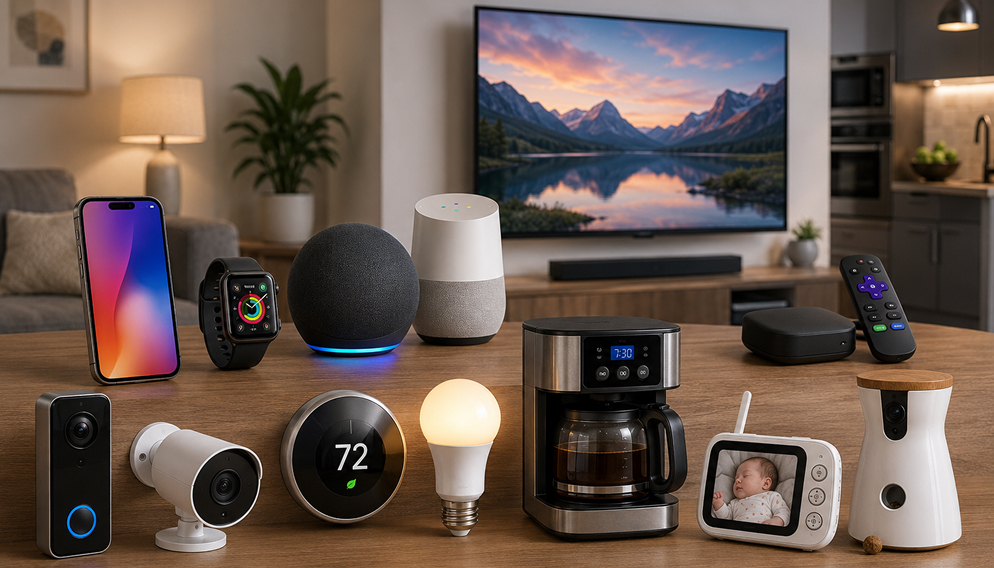
When people hear the phrase smart device, they often think of smartphones first.
While that’s certainly part of the picture, today’s connected ecosystem extends far beyond the phone in your pocket.
A smart device is any internet-connected gadget that can collect data, communicate with other devices, or automate tasks with little or no human intervention.
Many are powered by artificial intelligence, cloud computing, or the Internet of Things (IoT), allowing them to learn routines and respond to commands in real time.
Some of the most common examples include:
- Smartphones
- Smartwatches and fitness trackers
- Smart speakers and voice assistants
- Smart TVs and streaming devices
- Video doorbells and home security systems
- Smart thermostats and lighting
- Connected kitchen appliances
- Baby monitors and pet cameras
The Role Of Smart Devices In Relationships:
Do I really need to even talk about this?
For most of us, smart devices made having a relationship even possible back in the day – it made things super convenient for the first time. And once you are in, there is no going back.
There are so many apps for couples in the present day to ensure you are connected 24/7 – from having shared apps for groceries and shopping lists to apps for tracking your health, there’s an app for all occasions.
These are small conveniences and might not appear to be that crucial within a relationship.
But together, they shape how two people spend time, divide responsibilities, and even communicate with each other.
For instance, my boyfriend and I have demanding careers. Instead of messaging throughout the day just to coordinate errands, we use a digital calendar that updates automatically across both our phones.
Similarly, we have an app that syncs our shopping lists in real time. As a result, technology does not have to replace real communication. Rather, it eliminates the mundane so that we can focus on quality time.
Of course, the same devices can produce the opposite effect in some cases.
For instance, I have seen how my friend’s location-sharing app, which initially offered reassurance, became a tool her partner used to spy on her.
This dual nature is what makes smart devices such an interesting subject for relationship research.
Very few technologies are inherently positive or negative. Their effects depend on the expectations, habits, and boundaries of the people using them.
Understanding this distinction is important because conversations about technology often become overly simplistic. Some claim smartphones are destroying relationships, while others argue that technology simply reflects existing behaviours.
Reality lies somewhere in between.
The Reality:
A phone cannot create trust where none exists. Nor can it single-handedly ruin a healthy relationship.
What it can do is amplify patterns that are already there.
So, couples who communicate openly may find that technology strengthens their connection.
But couples who already struggle with communication may discover that constant notifications, social media, or digital distractions make those challenges even harder to navigate.
That’s why it’s more useful to ask not whether smart devices are good or bad, but how they influence different aspects of our relationships.
And what we can do to make sure they serve us rather than the other way around.
The Good: How Smart Devices Affect Relationships?
Speaking from my experience, if you have ever sneaked a look at your partner’s dirty message during a client pitch and blushed, chances are you are already experiencing the good effects of technology.
I know it doesn’t seem to be a lot in that moment – maybe it was just a shirtless pic, or a voice note calling you ‘beautiful.’
But you can’t build relationships with expensive gifts, long vacations, and quality time. Sometimes, it is built through small moments that scream, ‘I miss you!’
Smart devices have made those moments almost effortless.
1. Staying Connected Isn’t Equivalent To Talking For Hours:
My mother told me about how she would write letters to my dad – they would wait for days (sometimes weeks) during that time just to receive one letter from a loved one.
Things have certainly changed now. My partner and I call each other 5-6 times during the whole day, checking up on one another. Of course, those aren’t really meaningful conversations.
However, these conversations keep us going by creating a sense of presence. Life feels shared, even when people aren’t in the same place.
Psychologists sometimes refer to these as “bids for connection,” A.K.A small attempts to reach out and invite a response.
Technology hasn’t invented those moments. It has simply made them easier to create.
Of course, there is a catch. A hundred meaningless messages won’t strengthen a relationship if genuine conversations never happen.
But when texting, calling, and video chats support an already healthy relationship, they often make people feel more connected rather than less.
2. Long-Distance Relationships Aren’t What They Used To Be:
To be honest, I can’t imagine just how hard it must have been to be in a long-distance relationship without smartphones.
Today, you have specific apps for long-distance couples – couples now have dinner dates over video call.
But 20 years ago, phone calls were really expensive, and video calls did not really exist. So, all you had were emails, letters, or meticulously planned conversations.
Having said that, I can tell you no app can replace a hug – technology can’t replace the intimacy of physical touch.
However, technology definitely has closed a gap that once felt impossible to bridge.
Interestingly, research backs that up. Several studies have found that long-distance couples often report relationship satisfaction comparable to couples who live in the same city.
What matters isn’t proximity alone – rather, it’s the quality and consistency of communication.
In other words, technology gives people the tools. What they build with those tools is still up to them.
3. Sometimes The Biggest Relationship Win Is Fewer Arguments:
Most relationship conflicts don’t start with dramatic betrayals. They start with ordinary life. And this is where smart home technology quietly earns its place.
A shared shopping list updates itself while someone is cooking. A family calendar reminds everyone about school events before they become forgotten obligations. Voice assistants set reminders that don’t rely on one partner carrying the entire mental load.
None of that sounds particularly exciting. But isn’t that the point? The best technology often fades into the background.
It removes little sources of friction before they have the chance to become bigger frustrations.
The Bad: How Smart Devices Affect Relationships?
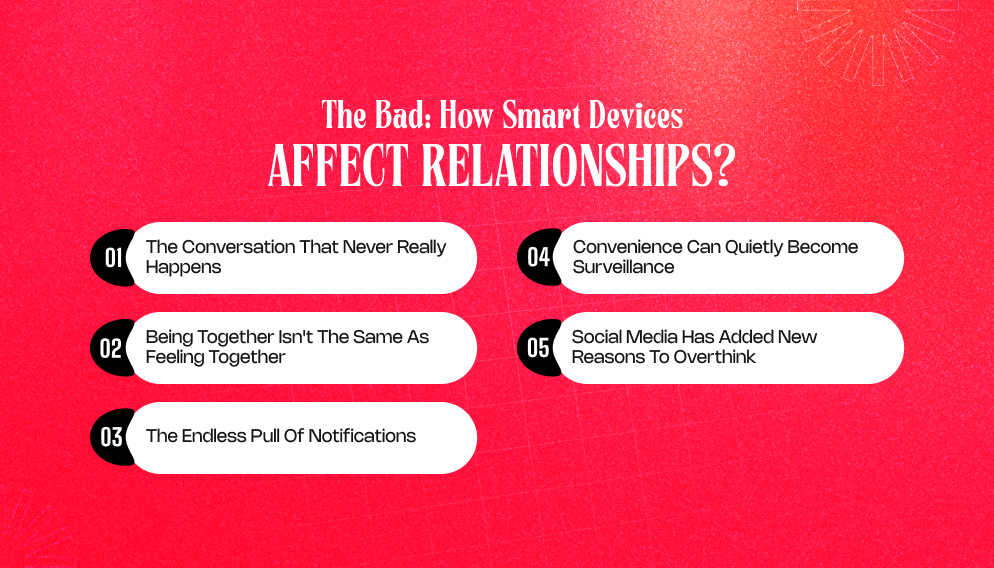
The problem with smart devices isn’t that they suddenly destroy relationships – it is probably happening for a while, and you failed to notice it.
More often, technology changes the rhythm of your relationship gradually. And it happens gradually in a way that nobody notices until the disconnect has already settled in.
Instead, it starts with checking one notification during dinner. Then answering a work email before bed.
Then scrolling through social media while your partner tells you about a frustrating day at work.
None of those moments feels significant. Yet relationships are built, and sometimes weakened, through exactly those ordinary moments.
1. The Conversation That Never Really Happens:
Picture this: you have been waiting throughout the day just to share some exciting news with your partner. Maybe you finally got promoted, or you got an exceptionally great hike.
So, you start talking.
Halfway through your story, they glance at their phone because it buzzes. They look back at you and say, “Sorry… what were you saying?”
It isn’t a fight, and you probably don’t even mention it. But still it starts to feel different. For me, I would have never been able to continue the conversation.
When this becomes a habit rather than an exception, people begin editing themselves. They shorten stories. They stop bringing up small things. Eventually, conversations become transactional instead of personal.
Psychologists have a name for this behaviour: phubbing, which is snubbing someone in favour of a phone.
The word sounds almost silly, but its effects aren’t.
Multiple studies have linked frequent phubbing with lower relationship satisfaction, more conflict, and greater feelings of loneliness. The reason isn’t difficult to understand. Being interrupted by a device sends a subtle message, even if it isn’t intentional.
Something else has your attention. Most people don’t resent the phone itself. But they resent what it represents.
2. Being Together Isn’t The Same As Feeling Together:
Walk into almost any café today. You will probably spot at least one couple sitting across from each other, both looking at separate screens.
While the couple is technically spending time together, whether they are actually connecting is another question.
Researchers sometimes distinguish between shared space and shared attention. So, while shared space is simply being in the same room, shared attention is choosing to focus on each other.
Romantic relationships need both.
This doesn’t mean couples should never check their phones.
Real life doesn’t work that way – Work messages arrive, and emergencies happen. But the issue is when distraction becomes the default.
Human beings are remarkably good at sensing divided attention. Even without saying a word, we notice when someone is only half listening.
3. The Endless Pull of Notifications:
One notification rarely arrives alone. A calendar reminder appears. Then a message, followed by breaking news.
Then an online sale, and then a friend shares a reel – needless to say, it goes on! So, by the time you’ve dealt with all of them, the conversation you were having has disappeared.
Technology companies spend enormous resources designing products that keep people engaged for as long as possible. Infinite scrolling, autoplay videos, personalised recommendations, and carefully timed notifications all compete for the same limited resource: attention.
Relationships happen to compete for it too.
That’s why many people feel mentally exhausted despite spending less time having meaningful conversations than previous generations.
Also, it’s difficult to be emotionally available when your attention is constantly being divided into smaller pieces.
4. Convenience Can Quietly Become Surveillance:
Location sharing is a good example of how the same feature can feel completely different depending on how it’s used.
For one couple, it’s practical, such as “I’m leaving work now,” or “Let me know when you get home.”
It sounds simple, really. But for another couple, it becomes something else, such as “Why were you at that café for forty minutes?” or “You said you’d already left.”
The reality? The technology hasn’t changed. But trust has.
Moreover, the same applies to shared passwords, access to social media accounts, and smart home cameras.
Some couples choose to share everything because it works for them. Others discover that constant access slowly replaces trust with monitoring.
Healthy relationships don’t usually require continuous proof of where someone is every minute of the day.
5. Social Media Has Added New Reasons To Overthink:
Arguments that once ended when people left the room now have a habit of following them online:
- Why did they like that photo?
- Who keeps commenting with heart emojis?
- Why haven’t they replied to my message when they’ve clearly been active?
Most of these questions didn’t exist twenty years ago.
Social media has introduced entirely new forms of misunderstanding because people often interpret digital behaviour without knowing the full context.
For instance, a delayed reply might mean someone was driving, which someone else sees as rejection.
So, a harmless interaction becomes evidence of something that never happened. Remember, technology didn’t create jealousy. It simply gave insecurity more places to hide.
What Research Actually Suggests?
It’s tempting to search for a simple verdict – are smart devices helping relationships or hurting them?
I was surprised to find that researchers have not found any objective answer, primarily because there is no factual answer.
On top of that, the evidence highlights something deeper and more nuanced – technology will only amplify your existing habits.
As a result, a couple with zero communication issues will have no problem staying connected via smart devices throughout the day. Similarly, couples with demanding schedules will use shared calendar apps to have shared experiences – and not for invading each other’s privacy.
However, if a couple has existing trust and communication issues, then technology can’t make things better in the relationship.
And that’s an important distinction.
Your phone isn’t making you thoughtful. It isn’t making you distant either. But it creates more space for existing habits to show themselves.
As a result, when used with intention, smart devices can reduce stress, strengthen communication, and make everyday life run a little more smoothly.
But when used mindlessly, they can do the exact opposite. And that’s where the conversation starts to become more complicated.
So, Are Smart Devices Really To Blame?
Not entirely.
Blaming technology for every relationship problem is a little like blaming kitchen knives for bad cooking.
They are tools and, needless to say, powerful ones. But still these are just tools. Phones don’t create poor communication. Instead, they expose it.
Location sharing doesn’t create distrust. Instead, it often magnifies doubts that were already there.
Social media doesn’t invent insecurity. Instead, it gives insecurity more opportunities to speak.
That’s why researchers increasingly argue that the question isn’t whether smart devices are good or bad.
A better question is this: Are these devices helping people invest more attention in their relationships or quietly pulling that attention somewhere else? For some couples, the answer is reassuring. But for others, it’s worth pausing long enough to notice what has slowly become normal.