I have been in a committed relationship for nearly eight years now – the irony? We met on Tinder at a time when people had just begun relying on dating apps for casual sex.
In fact, I installed Tinder because I just wanted to have some fun. So saying that technology doesn’t play a role in our romantic relationships – at least for me – isn’t going to work.
And it’s not just me – all the couples I know use technology to stay in touch throughout the day, irrespective of where they are located.
Some even use relationship apps to have difficult conversations, while others depend on technology to plan vacations, create monthly budgets, and even raise a pet.
However, there’s another side to it as well – and for people with low patience levels, technology can really screw things up at times.
So, the same phone that lets you and your partner stay connected throughout the day can end up interrupting dinner. Similarly, the phone that lets you plan trips together can turn a small disagreement into a prolonged argument.
Honestly, it is only normal to wonder: can technology actually improve your relationship satisfaction?
Of course, the answer is ‘yes,’ but you have to understand that digital tools exist to support relationship satisfaction only when they encourage connection, communication, and responsiveness.
Simultaneously, technology can easily impact any relationship when it interferes with your quality time or distracts partners.
The difference almost always comes down to how you are using technology and not how much technology you are using.
Today, I’ll discuss how technology affects relationships and break down whether it can improve relationship satisfaction.
Stay tuned.
What Is Relationship Satisfaction?

Relationship satisfaction is all about how positive you are about your relationship – rather, how you feel about your romantic equation.
So, if your partner is satisfied in the relationship, then it does not necessarily mean they will also be happy every day. I mean, at the end of the day, every romantic relationship undergoes disagreements, stressful phases, and frustrating moments.
But when it comes to satisfaction, you are looking at a bigger picture: Do you feel close to your partner? Do you feel heard and understood? Can you rely on each other?
Also, do you enjoy spending time together? At the end of the day, you need to find out whether your relationship meets your practical and emotional needs.
And these questions matter no matter what you think – this is because technology can impact several areas at the same time.
A thoughtful message may make someone feel remembered. A shared calendar may reduce arguments about plans. A video call may help partners maintain closeness across distance.
But a partner repeatedly checking their phone while you are talking can create the opposite feeling.
That is why asking whether technology is ‘good’ or ‘bad’ for relationships is too simple. The more useful question is: What does technology help couples do better?
Can Technology Improve Relationship Satisfaction?

TBH, it can. And I have enough data at my disposal to prove this.
For starters, a 2025 systematic review and meta-analysis examined digital interventions aimed at improving romantic relationship satisfaction.
Researchers reviewed 15 eligible studies, and most reported improvements in relationship satisfaction.
A meta-analysis of six studies found a significant, moderate effect, although the researchers noted that results varied by program, participants, and delivery method.
That distinction matters.
Technology itself is not a relationship treatment.
A relationship app does not automatically make two people happier. A video call does not create intimacy on its own. Also, a messaging app cannot teach someone to listen.
What technology can do is create opportunities for better relationship behaviors.
It can make communication easier. It can help couples stay connected. Also, it can provide structured exercises. All of this can make relationship support easier to access.
In other words, technology can become useful when it helps people do something that strengthens the relationship.
In this context, you can check out my deep-dive into healthy tech habits that can improve your relationship: Technology Habits That Strengthen Relationships.
How Technology Can Improve Relationships?
For me, technology has always been a blessing – but do you know why? It’s because my partner and I have always focused on quality over quantity.
So, for us, the focus isn’t on how much we use technology but rather how we use it. On that note, let’s check out how technology can improve relationships.
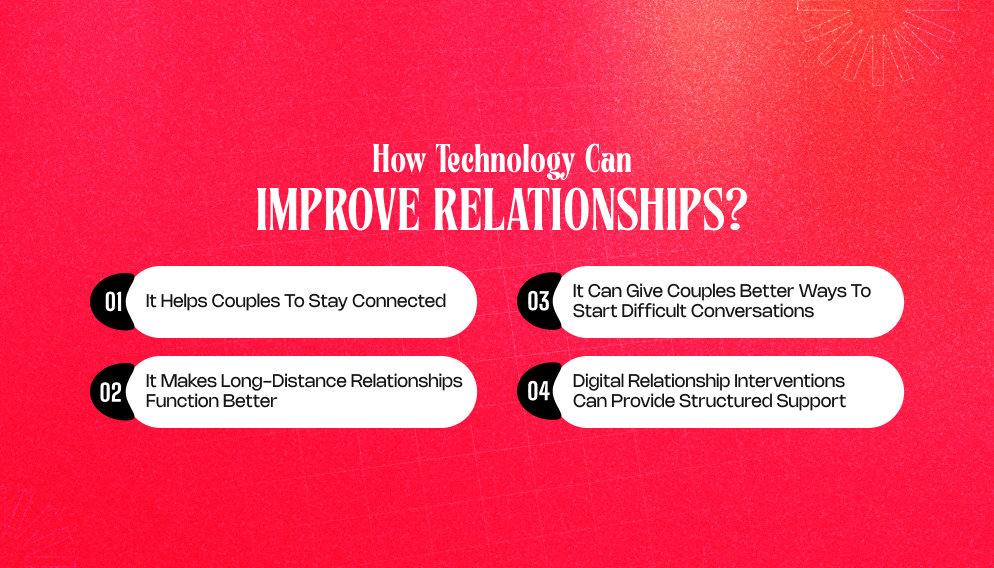
1. It Helps Couples To Stay Connected:
I feel small moments are super important in relationships, especially romantic ones.
A ‘How did your meeting go?’ text takes a few seconds. Similarly, sending a picture of something that reminds you of your partner hardly takes time or effort.
While these messages appear to be insignificant, they end up creating mini connection points throughout the day.
And for couples who spend a lot of time apart, technology offers an easy way of saying, ‘I’m thinking about you.’
That does not mean couples need to text constantly. In fact, constant communication can become tiring. Some people prefer a few meaningful messages, while others enjoy frequent updates.
The goal is not to create a perfect texting schedule. It is to make communication feel genuine and responsive.
2. It Makes Long-Distance Relationships Function Better:
There is no denying that technology has really changed what distance means for two people in a long-distance relationship.
A few decades back, long-distance relationships had to solely depend on occasional visits and phone calls. But today, couples can use technology to share parts of their daily lives with each other.
They can:
- Video call before bed.
- Send voice notes during a commute.
- Watch a film together online.
- Share photos from their day.
- Play games together.
- Eat dinner while on a video call.
- Plan future trips through shared apps.
- Send spontaneous messages throughout the day.
None of these replaces physical presence. Of course, they can’t replace physical intimacy – agreed!
But there’s no denying that these things can help couples create a shared life when they are apart. And that matters to long-distance couples since they work so hard to create a connection everyday.
Technology, in this case, is not competing with intimacy. It helps carry intimacy across distance.
In this context, you can check out my deep-dive into the best apps for long-distance couples: The Best Apps for Long-Distance Couples (Based on the Problems Real Couples Actually Face).
3. It Can Give Couples Better Ways To Start Difficult Conversations:
Some conversations are difficult to begin. For instance, you know there is something bothering you, but you just don’t know how to talk to your partner about the issue.
I would advise you to just write it all down somewhere – whatever you are thinking about. That way, the conversation with your partner will feel less overwhelming.
Also, technology can actually help you out in such situations. So, a couple might use a relationship app that provides weekly questions. They could keep a shared digital journal.
They could even agree to answer three questions every Sunday:
- Did I make you feel loved this week? And if ‘yes,’ then can you share what made you feel so?
- Did I do something that made you feel disconnected? And if ‘yes,’ then can you share what made you feel this way?
- Is there something we can do better next week?
Technology is not solving the problem. It is simply giving the couple a structure for talking about it. That can be useful because couples often avoid difficult conversations until the problem becomes much larger.
A prompt can make the first step easier.
4. Digital Relationship Interventions Can Provide Structured Support:
Of course, it is not fair to expect every couple to afford conventional relationship counseling.
And it’s not just money always.
Sometimes, it could be work schedules, privacy concerns, childcare, location, and even availability that can stop a couple from seeking relationship counseling.
Digital interventions can reduce some of those barriers.
The 2025 systematic review of digital relationship interventions found that many of the studies reviewed showed improvements in relationship satisfaction, with some benefits continuing at follow-up.
However, the researchers also stressed that digital interventions differed considerably in their design and effectiveness.
That means a couple shouldn’t treat every app or program on the internet as equally effective. So, the question that you need to ask is, “What does this tool actually help us practice?”
Does it encourage listening? Does it help partners express appreciation? Also, does it teach conflict-management skills? Those questions tell you much more.
Can Technology Help Couples Manage Conflict?

This is where things get complicated.
Most people have argued through text at some point. One person sends a message. The other responds. Someone misreads the tone. A second message follows. Then another.
Before long, a disagreement that might have taken ten minutes to resolve has become a long chain of messages.
So, is technology actually useful during conflict?
A 2026 systematic review examined technology-mediated conflict management in couples.
The review did a deep dive of 15 quantitative studies to compare two types of conflicts: face-to-face interactions and conflicts mediated by technology.
Researchers discovered that the outcomes from both conflicts didn’t differ from each other much – yep, the outcomes were pretty similar.
However, it is essential to acknowledge that these effects weren’t universal and could vary with factors like relationship satisfaction, self-esteem, and attachment style.
That gives us a more useful answer than “never argue over text.” Text communication is not automatically bad. But it is not automatically better either.
Technology May Help During Conflict When:
- You need time to organize your thoughts.
- You are trying to communicate something difficult.
- Writing helps you express yourself more clearly.
- You are temporarily apart.
- You agree to continue the conversation later.
It May Make Conflict Worse When:
- You keep sending messages while angry, expecting immediate responses.
- You use sarcasm that can easily be misunderstood.
- Bringing up several old arguments at once makes you feel better.
- You use silence to punish your partner.
- You avoid an important conversation by hiding behind text.
As a result, here’s a useful rule that you can follow: Use technology to start a difficult conversation if it helps. Do not let the screen become the place where the entire relationship is argued out.
In this context, you can check out my deep dive into couples and screen time here: Couples And Screen Time: How to Find A Healthy Digital Balance Without Hurting Your Relationship?.
When Technology Hurts Relationship Satisfaction

The problem is not always what technology adds to a relationship. Sometimes it is what technology takes away.
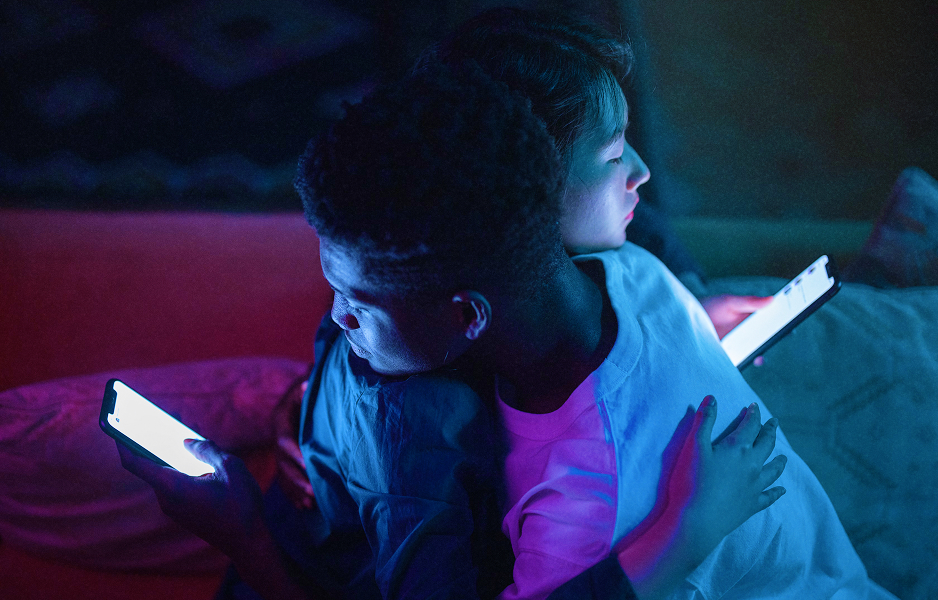
1. Technoference: When Your Phone Gets Between You
So, imagine you are in the middle of a deep conversation with your partner – it has been a long, hard day at work, and you are talking about it with your partner.
But your partner keeps checking his phone while you keep talking. And then randomly he says, ‘Sorry, what did you just say?’
Trust me, that moment has nothing to do with technology and how it is impacting your relationship. It is about attention.
Researchers often use the term technoference to describe technology interrupting or interfering with interactions between people.
A 2020 daily-diary study involving 173 romantic relationships found that on days when participants experienced more technology interference than usual, they reported feeling worse about their relationships.
And not just that, these couples also spoke about conflict over technology use, less positive face-to-face interaction, and more negative mood.
So, the problem isn’t your partner using their phones a little too much – rather, the problem is whether or not your partner is making you feel less important than his phone.
And that difference matters.
2. Social Media: Appearances Can Be Deceptive
With social media, you can share memories with the world, do some digital PDA, and express affection – I don’t see the problem here really, or so I thought.
So, I did forget about how social media can also introduce comparison – you see another couple traveling every weekend.
Someone posts flowers their partner bought them. Another couple seems to have perfect date nights every Friday. Your own relationship suddenly looks less exciting.
But social media rarely shows the complete relationship.
You see the anniversary dinner, not the argument before it. You see the vacation photo, not the financial stress behind it.
Also, you see the romantic caption, not the difficult conversation happening at home.
When couples compare their private relationship with someone else’s carefully selected public moments, dissatisfaction can grow for reasons that have little to do with their actual relationship.
Technology is not always creating the problem. Sometimes it is changing what people use as the measuring stick.
3. Digital Surveillance: It Damages Trust
Of course, I use technology to check where my partner is when he is traveling solo across the country. Similarly, when I return home late in the night, he tracks my location.
TBH, checking your partner’s location initially can feel reassuring. Looking through their online activity may feel like getting answers. Also, checking when they were last active may seem harmless.
But constant monitoring can turn insecurity into a routine. And you can build trust if you need to check your partner’s phone every few minutes.
Also, you need to understand that if your relationship is in constant need of surveillance for both of you to feel secure, then there is some underlying issue that you guys aren’t addressing.
To be fair, technology can actually show you where someone is – but it cannot tell you whether or not you trust them.
Can Relationship Apps Actually Make Couples Happier?
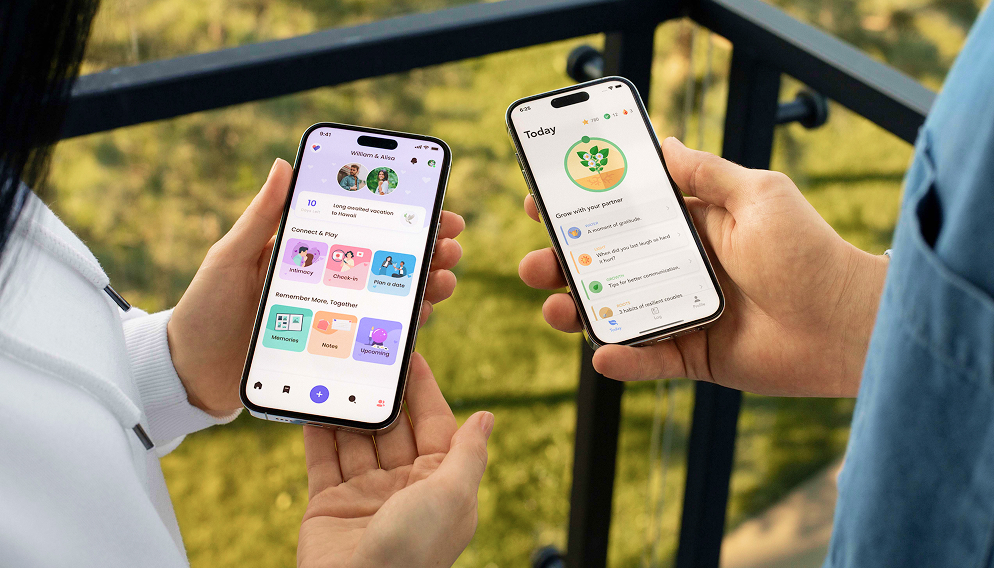
Of course, relationships apps are super helpful – they can make things better. But having said that, understand that expectations really matter as well.
So, a relationship app is most useful when it encourages couples to do something meaningful offline.
For example, an app might suggest a conversation about money. The useful part is not reading the question. It is having a conversation.
Another app might encourage couples to express appreciation. Again, the value comes from actually noticing and appreciating your partner.
This creates an important distinction: A relationship app should be a tool for connection, not a substitute for connection.
The best digital tools should lead couples back into the relationship itself. Also, such tools should encourage two people in a relationship to talk, listen, reflect, and grow together.
In this context, you can also check out my blogs on how technology impacts relationships and the digital boundaries that you can establish for a healthier approach.
- How Smart Devices Affect Relationships: The Good, the Bad, and What Research Says
- Digital Boundaries Explained: What They Are, Why They Matter, And How To Set Healthy Limits Online
- 11 Best Relationship Wellness Apps To Improve Communication, Trust, And Connection
What About AI and Relationships?

AI adds another layer to the conversation.
I mean, people are already using AI to generate appropriate conversation starters, seamlessly move through difficult conversations, plan romantic date nights, and even reflect on recurring relationship issues.
To be honest, AI can actually be useful in this context. For instance, if you don’t know how to start a difficult conversation, then you can ask AI for help.
Similarly, you and your partner can count on AI to discuss future plans, finances, and even family expectations.
Having said that, it is safe to mention that AI comes with a clear limit – AI can help you think about your relationship. It should not become a relationship.
Remember, AI doesn’t know your partner like you do. It didn’t make those memories with your partner – you made those memories, and you know him better.
Also, it does not understand the history behind a particular argument.
As a result, you can’t replace professional support with AI when your relationship hits rock bottom. Instead, it is healthier to use AI as a sort of prompt – and not as an authority who understands humans.
So, ask it to help you prepare for a conversation. Then have that conversation with the person who actually matters.
The 4C Test: Should Technology Be Part of Your Relationship?
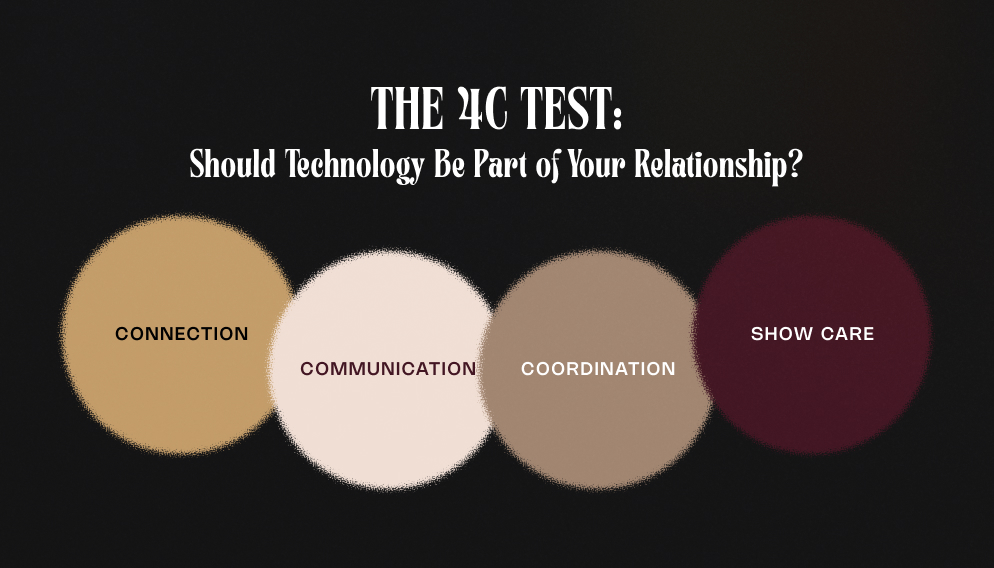
Before adding another app, habit, or digital tool to your relationship, ask four questions.
1. Does It Improve Connection?
Does it help us feel closer? A thoughtful voice note might. However, scrolling beside each other for two hours probably does not.
2. Does It Improve Communication?
Does it help us say something we might otherwise avoid? A relationship prompt might. However, sending passive-aggressive messages probably does not.
3. Does It Improve Coordination?
Does it make everyday life easier? Shared calendars, reminders, travel planning, and shopping lists can reduce unnecessary stress. Moreover, that matters because fewer logistical arguments can leave more room for actual connection.
4. Does It Show Care?
Does technology help us pay attention to each other? A reminder about an important appointment can show care. Also, sending encouragement before a difficult meeting can show care. Remembering a partner’s preferences can show care.
Technology And Relationship Satisfaction: What Actually Matters?
The research does not give us a simple answer.
Technology can improve relationship satisfaction. Also, it can make relationships harder. Both things can be true.
Digital interventions have shown promise in improving relationship satisfaction. Digital communication can help partners stay connected. Even small details of online communication, such as emotional cues in messages, can influence how responsive a partner feels.
At the same time, technology interference and partner phubbing are linked with poorer relationship experiences.
So the real dividing line is not between technology and no technology – It is between technology that supports connection and technology that competes with it.
A shared calendar can reduce stress. A video call can bridge distance. Similarly, a thoughtful message can make someone feel remembered.
Also, a relationship app can start an important conversation. But a phone on the table can also become the third person at dinner. And no app can make someone listen when they have decided not to.