
Picture this: after a long and exhausting week, you and your partner are on a romantic dinner date at a fancy restaurant – a reservation that took you guys weeks to get.
In the middle of dinner, your partner gets a work call and spends the next 30 mins on his phone.
You guys are together, but you are still eating alone. For 30 mins, he is on his phone, and once that ends, his head is still thinking about work.
So, even if you spent time together, you actually didn’t have any meaningful conversations – neither of you actually feel connected at the end of the date.
TBH, in this tech-dominated world, moments like these have become surprisingly common.
There are so many devices that have made it easier to stay informed, entertained, and connected with the outside world. But at the same time, the same devices are quietly competing with the people sitting right beside us.
This doesn’t mean technology is ruining relationships, even if most of you blame the device and not your partner’s habits.
Don’t forget that technology has made staying in touch easier than ever before. But the challenge begins when screens replace presence.
So pause for a few minutes and think about why a quick glance at Instagram turns into an hour of mindless scrolling.
At the end of the day, finding balance does not mean you will have to get rid of social media from your phone. Instead, it simply means you need to be more intentional about using technology to shape your daily interactions.
Today, I will discuss how screen time impacts relationships, the signs your digital habits might be creating some distance between you and your partner, and most importantly, actionable ways to build a healthy digital balance in your relationship.
Stay tuned.
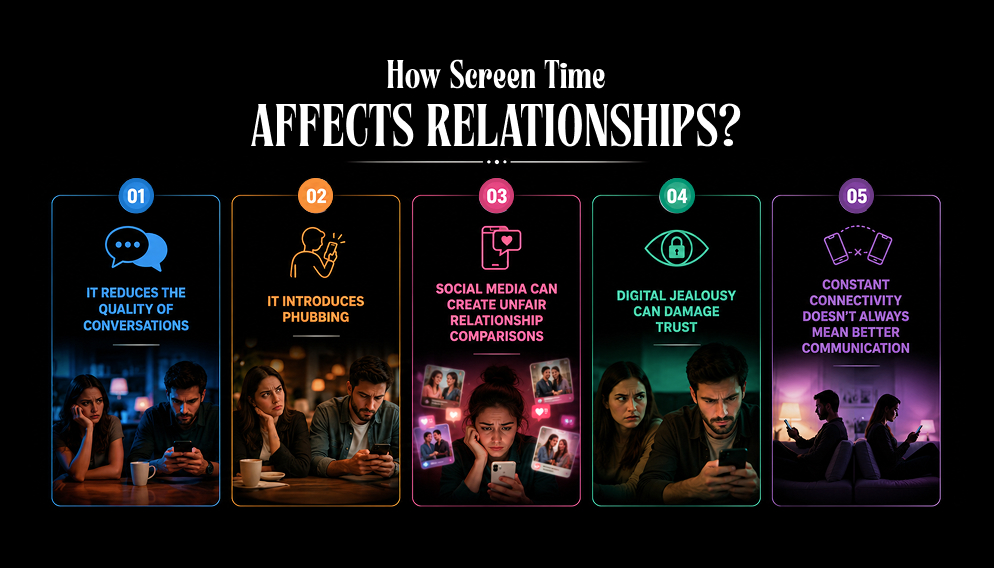
How Screen Time Affects Relationships?
Nobody will agree that screen time can damage a relationship over a night or even a week. Generally, it starts very small – so small that most people don’t even notice it.
Sometimes, it’s just that your partner lets work calls interrupt all conversations you have with him. Or maybe he would scroll for a few minutes before, and now that has turned into hours of mindless scrolling.
It’s not one action – rather, it’s a number of things that repeat every day! Over time, these moments begin to shape how connected two people feel.
As a result, understanding these patterns in your relationship is perhaps the first step towards finding the right digital balance in your relationship.
On that note, let’s look at all the possible ways in which screen time affects your relationship.
1. It Reduces The Quality Of Conversations:
Most couples talk every day – I mean, that’s only normal. But on a closer look, you will see that not every conversation creates connection.
For instance, imagine you are sharing something exciting with your partner – maybe you cracked a major deal or got promoted. In the middle of your story, you see that your partner is checking their phone because a notification just popped up.
Yes, they are still healing, but it almost feels like you don’t have his complete attention. And these are moments that often create resentment even when your partner didn’t do any such thing consciously.
Remember, good conversations depend on attention. And quality will always matter more than quantity.
2. It Introduces Phubbing:
One of the biggest relationship challenges linked to technology even has its own name.
Phubbing combines the words ‘phone’ and ‘snubbing’ – it describes the act of ignoring someone in favor of a mobile device.
To be honest, phubbing is more common than most people would like to believe.
For instance, you scroll through social media during dinner. Or, you answer emails while watching a film together.
Each moment feels small. However, when these actions are repetitive in your daily life, it can begin to impact your relationship.
But the issue is not the phone. Rather, it is about the lack of attention – it makes your partner feel like they don’t have your attention. Remember, healthy relationships thrive only when both partners feel seen, heard, and most importantly valued.
3. Social Media Can Create Unfair Relationship Comparisons:
As a self-proclaimed Instagram addict, I love spending a lot of time on my socials and sharing couple reels with my partner.
Now, while on the surface it doesn’t matter, it is essential to acknowledge that these reels end up creating unrealistic expectations – because Instagram only offers a glimpse of a relationship.
So, from what we are able to see, life is fantastic for the couple.
But often, the reality is different – there are couples who genuinely like doing PDA online, but does that mean their relationship doesn’t undergo any difficult phases?
Not everyday cannot be about fun dates, luxury holidays, romantic dinners, and lots of surprises.
There are going to be boring evenings, financial stress, fights, and plenty of disagreements as well – but chances are nobody is going to post them.
As a result, when people compare their everyday relationship with someone else’s carefully edited moments, dissatisfaction can quietly grow.
Remember, every relationship has challenges, and every couple expresses love differently. What works for one relationship may not suit another.
4. Digital Jealousy Can Damage Trust:
Technology has made communication easier – and nobody can deny that. But to be fair, you have to understand that it has also created new problems that didn’t exist before.
For instance, a ‘last seen’ status, an unanswered message, a new follower, or a comment on someone else’s photo can quickly become the starting point of an argument.
Of course, there could be a genuine reason behind such concerns. But usually, these concerns are based on assumptions – and not facts.
For me, I always look at technology as a blessing – it does offer us more information than ever before. But the problem is it does not always provide any context.
Remember, healthy relationships depend on trust, not constant digital monitoring. As a result, checking someone’s online activity may offer temporary reassurance, but it rarely builds lasting confidence.
5. Constant Connectivity Doesn’t Always Mean Better Communication:
Many couples stay in touch throughout the day – I absolutely hate it. But it works for many couples. For us, we mostly call each other a few times to check in – where we are, what we ate, and when we will go home.
As someone who has worked in corporate for eight years, I can tell you that I’ve called my partner to rant only when something major happens at work or I get overwhelmed with work stress.
While small interactions can strengthen emotional connection, problems can also arise when communication becomes an obligation instead of a choice.
For instance, your partner might expect you to reply immediately to his messages. But it’s not possible because you are at work and in the middle of something or the other. Then the pressure to reply immediately can make things stressful instead of comfortable.
Remember that healthy communication leaves room for individual responsibilities. So, just because you are getting late replies, it does not mean they don’t care.
Also Check: Relationship Tracker: The Complete Guide To Measuring And Strengthening Your Relationship In 2026
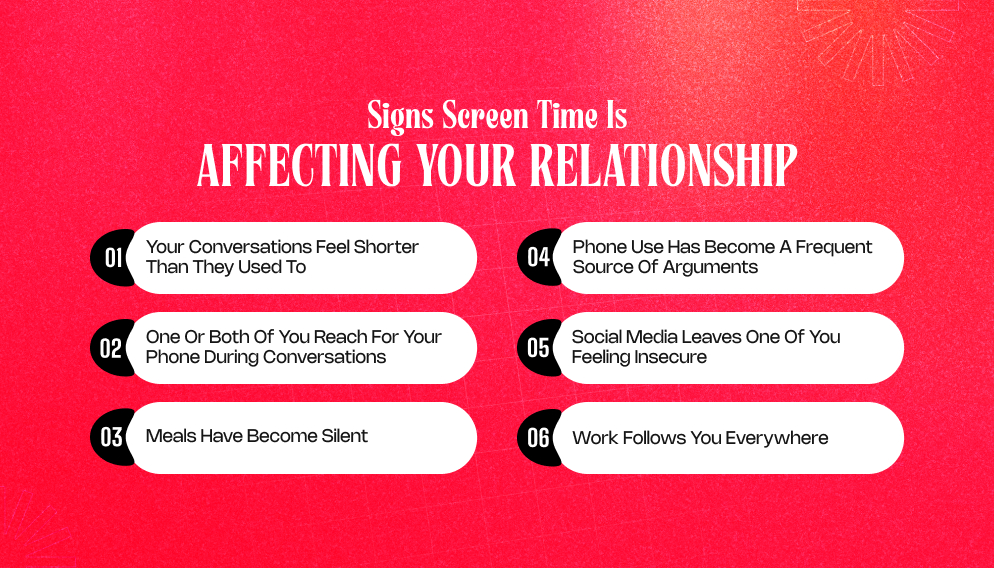
Signs Screen Time Is Affecting Your Relationship
Personally, just understanding the unhealthy relationship patterns isn’t enough.
And this happens because most couples fail to notice the signs that clearly indicate their relationship is impacted by screen time.
Honestly, if you think there’s going to be one major argument or a moment when everything in your relationship will change. But instead, the distance gradually develops through several small habits that ultimately become a part of everyday life.
As a result, it is essential that you are able to identify these habits early on – that way, it makes things much easier for you and your partner to work on.
In this context, here are some of the biggest signs that technology might be creating more issues in your relationship – instead of strengthening it.
1. Your Conversations Feel Shorter Than They Used To:
Think about the last time you had a meaningful conversation with your partner. Not a discussion about groceries, bills, or weekend plans.
But a conversation where you both listened, laughed, shared your thoughts, or talked about something that mattered. If those moments have become rare, screen time may be playing a role.
Remember the issue isn’t the amount of time you spend together. Instead, it’s the quality of your attention while you’re together.
2. One Or Both Of You Reach For Your Phone During Conversations
Imagine telling your partner about a stressful day at work. Just as you’re explaining what happened, they glance at their phone because it buzzes.
They may only look away for a few seconds. But those few seconds can make you feel less important than the notification.
Over time, repeated interruptions can discourage partners from sharing their thoughts altogether.
3. Meals Have Become Silent:
Sharing a meal has always been one of the easiest ways for couples to reconnect. For me, it’s a chance to slow down and enjoy each other’s company without rushing.
But when phones become part of every meal, those opportunities often disappear. Instead of talking, one person scrolls through social media while the other watches videos or replies to emails.
The silence may feel comfortable at first. Eventually, it can become a habit that replaces conversation altogether.
4. Phone Use Has Become A Frequent Source Of Arguments:
Arguments about screen time rarely begin with the phone itself. So, they usually begin with what the phone represents – One partner feels ignored, while the other feels controlled.
Now, if similar disagreements happen regularly, it’s worth discussing the underlying issue instead of focusing only on the device.
5. Social Media Leaves One Of You Feeling Insecure:
Social media can create misunderstandings that wouldn’t exist offline. Maybe one partner feels uncomfortable about certain comments or follows.
Sometimes neither partner has done anything wrong. However, the disagreement comes from different expectations about online behavior.
In such cases, talking openly about those expectations is usually more helpful than making assumptions based on likes, comments, or online status.
6. Work Follows You Everywhere:
Technology has made flexible working possible. But at the same time, it has also made switching off much harder.
So, if work emails interrupt dinner, weekends, holidays, or conversations with your partner, your relationship may start competing with your career for attention.
The problem arises when interruptions become the norm instead of the exception.
How Healthy Couples Manage Screen Time?

Frankly, most couples use technology differently. So, don’t assume that a couple in a healthy relationship will not use their phones at all.
Instead, someone in a healthy relationship will create habits that will bring out the best in each other – technology won’t become their enemy. But rather make their relationship better.
On that note, here are some screen time habits that many couples might find helpful.
1. They Put Their Phones Away During Meals: Yes, dinner lasts for only 30-40 minutes. But why not keep your phone away – why not use the time to reconnect?
2. They Don’t Solve Arguments Through Text Messages: Of course, texting is super convenient. But texts can make things worse during a fight because they are easy to misunderstand. So, why not save the important conversations for face-to-face discussions or phone calls?
3. They Respect Each Other’s Response Times: Not every message needs an immediate reply. Healthy relationships are built on trust, not constant availability.
4. They Create Screen-Free Moments: Understand that it is not about having ‘screen-free’ days. Rather, it is about protecting small parts of your whole day like morning coffee, dinner, or an evening walk.
5. They Use Technology Together: Technology doesn’t always have to create distance. Sometimes it creates shared experiences like watching a documentary together or planning your next holiday online – it’s about creating shared experiences via technology.
Small Habits That Make A Big Difference:
Frankly, improving your relationship doesn’t require deleting every app or taking a week-long digital detox.
Most lasting changes begin with small, realistic habits. So, you could start by putting your phones away during dinner. Or take a short walk together after work without checking notifications.
Also, I recommend choosing one evening each week for a phone-free date night. Additionally, how about turning off notifications that don’t truly matter? Or how about calling each other instead of discussing important issues through long text messages?
I know these habits may seem ordinary. But when repeated consistently, they create more opportunities for conversation, laughter, and connection. Relationships are rarely strengthened by one grand gesture. They are built through small moments that happen every single day.