As a corporate slave for eight years, I’ve seen enough – stolen glances by the elevator, brushing their knees against each other inside the conference room, and long drives after work.
In most cases, the two people involved in an intimate relationship at work are probably married or in a long-term relationship.
And while they are not exactly cheating on their partners with someone they met at work, they are definitely tiptoeing around the boundaries of what constitutes cheating.
Of course, millennials would outright call it out as cheating, but our favorite generation – Gen Z – has a name for this as well, and it’s called micro cheating.
So, what is micro cheating? It is one of those relationship terms people immediately argue about because nobody agrees where the line actually is.
For one person, it is harmless behavior. For another, it feels like emotional betrayal hiding behind technicalities.
And honestly, that tension is exactly why the term exploded online.
Moreover, modern relationships are full of situations that did not really exist a decade ago:
- Late-night Snapchat streaks.
- Secret Instagram reactions.
- ‘Just friends’ texting all day.
- Emotional dependency through DMs.
- Dating apps were kept ‘for fun.’
- Hidden conversations that somehow never get mentioned openly.
Of course, none of these automatically means somebody is cheating. But they can still feel wrong. That gray area is where micro-cheating lives.
And today, I’m going to dissect micro-cheating, touching upon all the gory details of infidelity in modern relationships.
Stay tuned.
What Is Micro Cheating?
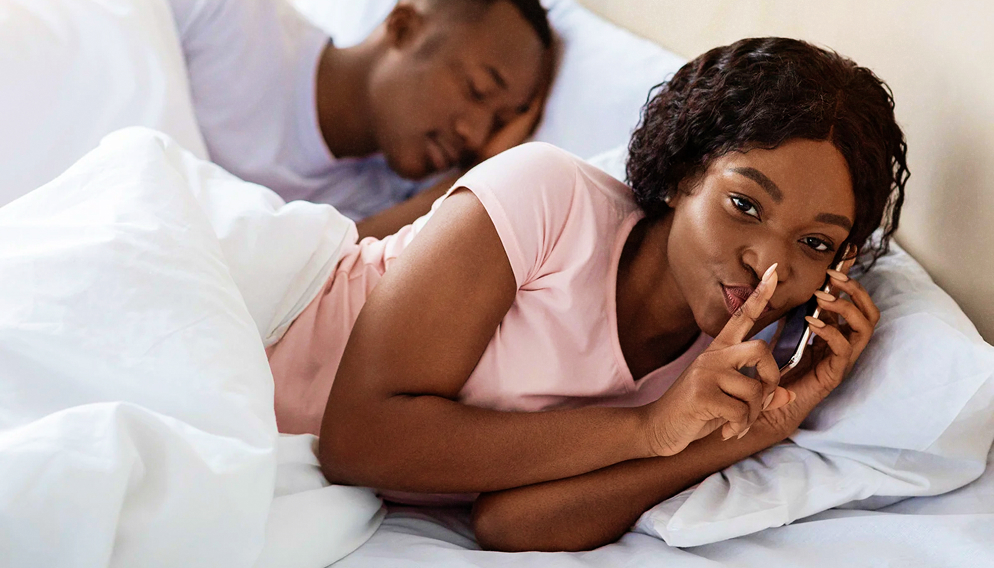
Micro cheating usually refers to small actions that create emotional, romantic, or flirtatious intimacy outside a committed relationship without crossing into obvious physical cheating.
Moreover, note that the primary keyword here is ‘micro.’
That is why people get confused by it. So, we are not talking about full affairs or secret hotel rooms. Instead, the behavior usually looks subtle at first:
- Constantly messaging one specific person.
- Hiding conversations.
- Deleting chats.
- Flirting ‘as a joke.’
- Seeking validation from somebody outside the relationship.
- Emotionally prioritizing another person.
Individually, some of these actions may seem harmless.
But relationships rarely break from one dramatic moment. More often, trust erodes slowly through repeated small behaviors that start feeling dishonest together.
That is why micro cheating feels so emotionally messy. Also, while the actions themselves are often small, the emotional impact is not.
Why People Care About Micro Cheating So Much?
Because modern dating has blurred boundaries completely.
Social media gave people unlimited access to attention, validation, emotional escape, and old romantic connections.
Now, somebody can maintain emotional intimacy with another person without technically cheating in the traditional sense.
And honestly, that changes relationships more than people admit.
Moreover, a lot of couples are no longer arguing about physical affairs first. Instead, they are arguing about:
- Emotional availability.
- Hidden digital behavior.
- Online flirting.
- Secret conversations.
- Attention is going elsewhere.
As a result, the problem is that emotional betrayal is harder to define cleanly than physical betrayal.
Also, you cannot screenshot intention.
Common Signs Of Micro Cheating:
This is usually the section where people start mentally reviewing their own relationship.
Not every example below automatically means somebody is cheating. Instead, context matters, personality matters, and more importantly, relationship boundaries matter.
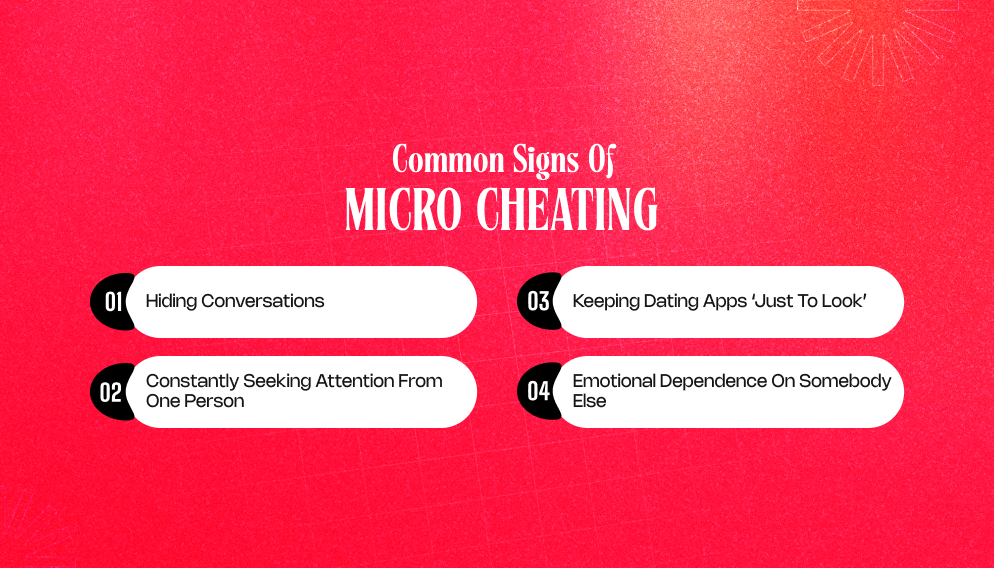
Still, these are some of the most common signs people associate with micro cheating:
1. Hiding Conversations:
This is one of the biggest red flags for many people.
Not because private conversations are automatically wrong, but because secrecy changes how behavior feels.
So, if somebody constantly:
- tilts their phone away,
- deletes messages,
- archives chats,
- hides notifications, or
- changes contact names.
Then naturally, suspicion grows. Also, people rarely hide interactions they genuinely believe are harmless.
2. Constantly Seeking Attention From One Person:
This happens more often than people realize.
Maybe somebody always reacts to the same person’s stories. Maybe they flirt subtly in comments.
Also, maybe they suddenly become emotionally energized whenever that person texts. Again, none of this proves cheating on its own.
But sustained emotional focus outside the relationship can start feeling deeply uncomfortable for the partner watching it happen.
Moreover, this is especially true when the emotional energy feels stronger online than inside the actual relationship.
3. Keeping Dating Apps ‘Just to Look.’
This one starts arguments constantly. Some people genuinely keep apps like Tinder or Bumble out of boredom, curiosity, or validation.
But others see having active dating apps in a relationship as immediate betrayal. That difference in perspective matters.
But realistically, if somebody feels the need to secretly browse dating apps while committed, there is usually already some emotional disconnect happening somewhere.
4. Emotional Dependence On Somebody Else:
This is where micro cheating often overlaps with emotional cheating.
As a result, if somebody starts sharing personal struggles, emotional intimacy, relationship frustrations, and daily dependence with another person instead of their partner, then the connection can quietly become emotionally loaded very fast.
And honestly, emotional intimacy is sometimes more threatening than physical attraction because it creates attachment.
You May Also Like: What Is A Monogamous Relationship? Has Monogamy Evolved In 2026?
Is Liking Photos Micro Cheating?
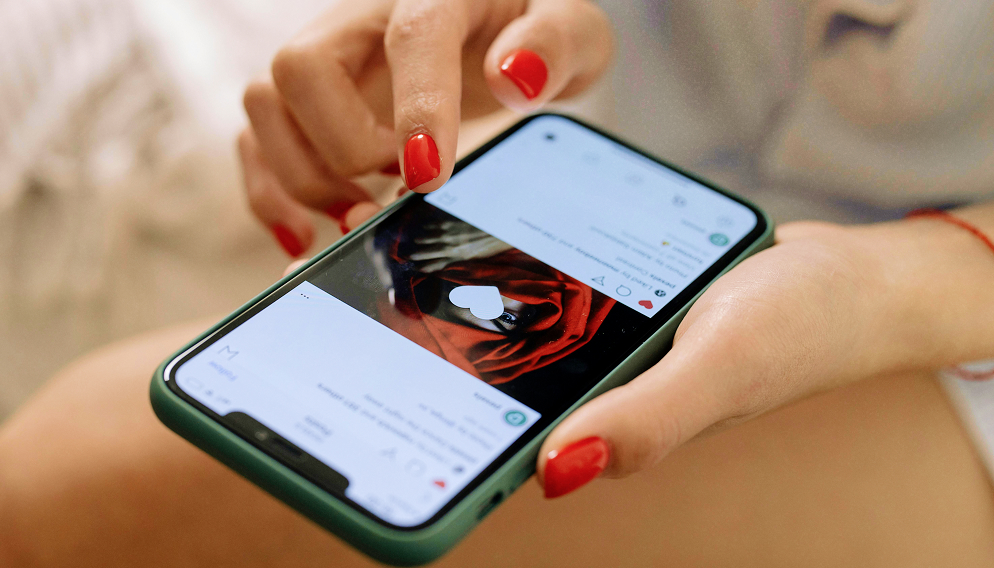
This question alone has probably caused thousands of relationship fights. Frankly, the answer depends entirely on context and frequency.
So, if they are randomly liking somebody’s picture, then it is usually harmless.
But, obsessively liking every single selfie from one person at 1 a.m. while secretly messaging them? That starts feeling different.
Moreover, people are often less bothered by the action itself and more bothered by the intention behind it.
That is why couples struggle to define boundaries online. Also, the exact same behavior can feel innocent in one relationship and disrespectful in another.
Why Social Media Made This Worse?
Because attention became permanently available.
Think about it: previous generations did not carry hundreds of potential emotional distractions inside their pockets all day.
Now people constantly have access to their:
- Exes.
- Old crushes.
- Coworkers.
- Strangers.
- Validation loops.
- Private conversations.
Moreover, social media platforms are literally designed to encourage interaction. That does not mean everyone cheats.
But it absolutely means that temptation, emotional curiosity, and boundary confusion became much more normalized.
Micro Cheating Vs Emotional Cheating:
People often use these terms interchangeably, but they are not always the same thing.
Micro cheating usually describes smaller behaviors that suggest blurred boundaries or hidden emotional investment.
However, emotional cheating tends to go deeper and usually involves:
- Stronger emotional attachment.
- Intimacy replaces the relationship.
- Emotional dependency.
- Romantic connection without physical involvement.
Also, you can think of micro-cheating as a behavior that sometimes leads toward emotional cheating if boundaries keep slipping.
Of course, not always, but often.
Also Check: If They Are Hot And Cold, Read This Before You Chase Again
Can Micro Cheating Ruin Relationships?

Yes, completely. Not always because of the action itself, but because of what happens once trust gets damaged.
TBH, a lot of people can survive flirting more easily than dishonesty. Moreover, what usually hurts in such situations includes:
- Secrecy.
- Emotional withdrawal.
- Hidden attention.
- Repeated lying.
- Feeling emotionally replaced.
As a result, once somebody starts wondering, “What else is happening that I do not know about?” the relationship often changes permanently.
Also, trust becomes investigative instead of natural.
And relationships struggle once people start monitoring each other emotionally instead of feeling secure.
Does The Term Gets Overused?
But the term also gets overused sometimes, and this matters too.
Not every friendship is micro-cheating. Moreover, not every interaction with an attractive person is a betrayal.
And not every relationship should involve controlling somebody’s entire social life.
Of course, there are some people who misuse the term because of insecurity, jealousy, or fear. And honestly, that can become unhealthy very quickly.
As a result, a partner should still be allowed to:
- Have friends.
- Talk to coworkers.
- Interact socially.
- Exist online normally.
The real issue is usually not interaction itself.
Instead, it is secrecy, intention, emotional energy, and whether somebody is quietly crossing boundaries they know would hurt their partner if fully visible.
How Couples Can Avoid Micro Cheating Problems?
Honestly, most problems start because couples never discuss boundaries clearly until after someone gets upset.
Moreover, often, people just assume their definition of loyalty is obvious. But usually, it is not so.
As a result, you and your partner need to have healthy conversations around:
- Flirting.
- Social media behavior.
- Exes.
- Emotional intimacy.
- Dating apps.
- Online friendships.
Trust me, this will prevent a lot of confusion later, and do it at the initial stages of the relationship – yes, even before you enter the Honeymoon phase.
Because every relationship has different comfort levels. So, the important part is that both people actually understand them.
Additionally, at its core, micro cheating is about emotional ambiguity.
Instead, it is the space between “I technically did nothing wrong” and “You still made me feel betrayed.”
That is why the topic creates so much debate online.
Most people instinctively recognize when something feels emotionally dishonest long before they find the perfect definition for it.
And honestly, maybe that is the real reason the term became so popular. Also, modern relationships are no longer just about defining cheating. They are trying to define loyalty in an era where attention is available everywhere, all the time.