
Of course, it is embarrassing to admit that you are trying to figure out how to rekindle sexual desire.
My social skills and some traumatic dating experiences tell me it is super common.
Let me tell you about one incident. I was dating a friend for eight months – turns out we were great as friends, but as lovers?
We were bad together – and I don’t want to waste time discussing everything that went wrong.
But one of the most problematic things about that relationship was the lack of passion – initially, there was chemistry, but soon it fizzled out.
And in the midst of ‘love you-s,’ and ‘take care-s,’ my sexual expectations fell through.
Naturally, once the relationship ended and I moved on, my expectations were at an all-time low, and I didn’t even realize what my body already knew for months.
When I met my current partner, we were all over each other, and even if I thought it was just the Honeymoon phase, and it wouldn’t really last, I was really shocked.
Shocked by the reactions he would get out of my body. And it’s been over seven years, then – we are still very attracted to each other.
I know exactly what we did right – I am consciously aware, and if something goes awfully wrong between us, I know we’ll always have a way to get back.
Today, I’m going to spit out some hard truths – and when you think back, it might align with what has already been happening to you.
So, stick around while I break down why we lose chemistry, how it usually starts outside the bedroom, and how more sex is not going to solve it.
More importantly, I’m here to share my secret tips on rekindling sexual desire in your relationship.
Stay tuned.
The Desire Gap: Addressing The Loss Of Sexual Desire

When sexual desire fades, many couples focus on the wrong place. They focus on sex itself.
So, they buy lingerie, schedule date nights, try new positions, or push themselves to be more spontaneous. While these efforts can help, they often fail to address the real issue.
That’s because sexual desire rarely exists in isolation. Instead, it is connected to how we feel about ourselves, our relationships, our responsibilities, and our daily lives.
Also, in many cases, the loss of sexual desire begins long before anyone notices changes in the bedroom.
It starts with emotional disconnection, unresolved resentment, or with stress that never seems to end. Sometimes it starts with feeling unseen, unheard, or taken for granted.
Other times, it begins when life becomes so busy that intimacy slowly slips to the bottom of the priority list.
This is why more effort is not always the answer.
Moreover, when desire disappears, many people assume they simply need to try harder. They force intimacy when they are exhausted.
Also, they create pressure around sex. They worry about whether something is wrong with them or their partner.
Ironically, that pressure often makes desire feel even more distant.
Desire thrives in environments where people feel safe, connected, and emotionally present. Instead, it struggles when relationships become another source of stress.
This is also why sex is not always the answer.
A lack of desire can sometimes be a symptom rather than the problem itself. Having more sex may temporarily address the symptom, but it does not necessarily solve the underlying cause.
As a result, if emotional needs remain unmet, trust has been damaged, or one partner feels overwhelmed by life’s demands, the desire gap often remains.
Here’s What To Do Instead:
Think of sexual desire as a signal rather than a switch.
When desire changes, it may be pointing toward something that needs attention elsewhere.
Perhaps the relationship has become too focused on logistics and responsibilities, or maybe communication has broken down.
Perhaps one or both partners are carrying emotional burdens that have nothing to do with sex but affect intimacy nonetheless.
The good news is that lost desire is not always lost forever.
When couples stop treating sexual desire as a standalone problem and start looking at the bigger picture, they often uncover opportunities for deeper connection.
In many relationships, rebuilding desire begins with rebuilding emotional closeness, trust, appreciation, and a sense of partnership.
The bedroom matters. But the foundations of desire are often built everywhere else.
Check Also: What Does Intimacy Mean? Most People Confuse It With Love, Attraction, Or Sex
How To Rekindle Sexual Desire?
Frankly, I did read what Gottman had to say about rekindling sexual desire – and while it is expert-led and they are well-equipped, I feel the advice has no heart and soul.
It almost feels like something I would read about a CRM dashboard or an Instagram marketing blog by Hubspot – I mean, hello, we were talking about matters of the heart.
And it’s not just Gottman – all the top blogs, including Guardian and Psyche, have just highlighted ten or so tips that will help you to rekindle sexual desire – absurd, right?
Since I don’t have a heavy degree in psychology, you might doubt me – but for a change, trust me and follow my advice.
I am in a long-term relationship, and my sex life is fantastic – based on my experience, here’s what you need to change or introduce in your relationship.
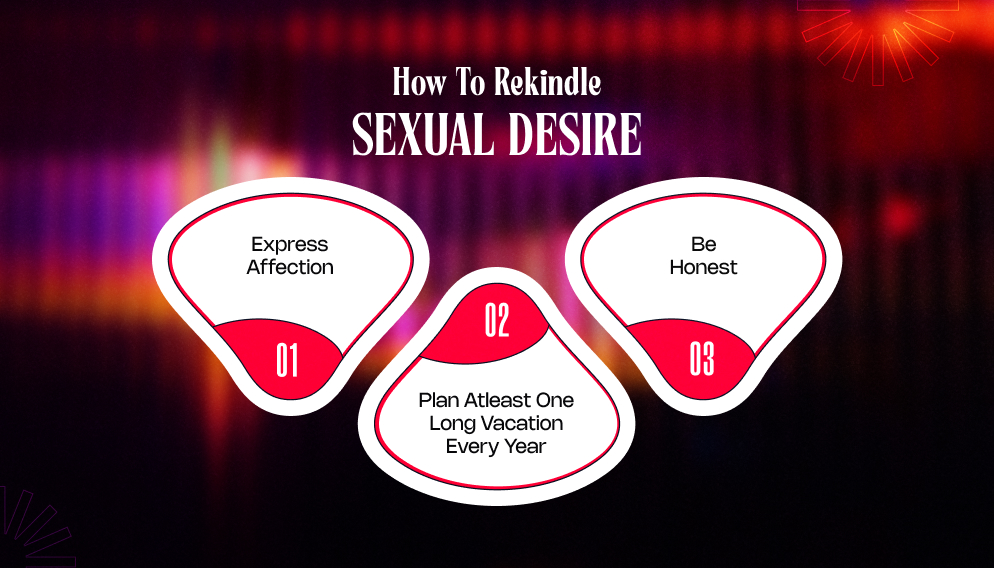
Hopefully, my three-step guide will help you improve things. If not, then I’ve added a detailed checklist that will most definitely work!
1. Express Affection:
This is easier said than done. Of course, everyone is different and has their own way of expressing affection. But it is essential to identify if it is happening or not.
As an example, here’s how my partner and I express affection for one another.
- We hold hands when we are outside.
- We tell each other ‘love you’ at the end of a conversation over the phone.
- I always go to see him off when he is traveling (and he travels a lot). Also, I’m always there to pick him up.
- He always plans my birthday and our anniversary, complete with a surprise.
- He always calls me ‘beautiful’ when I video call him before work – and it boosts my confidence.
These are just some daily habits – sounds superficial, but it builds affection in the long run. So, try it out and find out for yourself.
Also, understand that consistency is super important here – it cannot be something you guys do once in a while. It has to be a daily habit – something you do out of love every day.
2. Plan Atleast One Long Vacation Every Year:
Again, easier said than done.
As working adults, it is not always easy to plan a long trip together. Moreover, when schedules don’t match, going away for the weekend or planning something short during the week becomes a common practice.
And while we do that often, it doesn’t contribute to anything sustainable – it is as temporary as the trip itself.
In my experience, having atleast one long vacation together every year can do wonders for the relationship. We try to go away for 10 days every year – just the two of us, far away from everything. And it has only made us stronger.
It happened normally in the first year of the relationship.
And somehow, since then, we have stuck to it, even when our lives got busier, schedules refused to match, and even the weather didn’t support us.
3. Be Honest:
These three things walk hand-in-hand – without these three things, you can’t have a good sex life.
Most people live a life without being honest about their desires. If I love someone, why can’t I tell them what I like, and more importantly, what I don’t?
Moreover, honesty can make or break your relationship, including your sex life – stop looking at it as an isolated parameter.
In reality, a good sex life is the result of transparency and consistency in your relationship. I can guarantee you there is nothing about my boyfriend’s life that I don’t know – and vice versa.
Doesn’t mean we have never done anything questionable or immoral, but the difference is he knows, and he doesn’t judge me.
So, you can call him up and tell him all about how I’m a bad person, but he won’t care.
For us, the priority has always been each other, above anyone else. As a result, trust is the backbone of sexual intimacy in our relationship.
He makes me feel free and alive – I can tell him what I desire, what my body needs, and what makes me happy. And guess what? He will love me more for it.
How To Rekindle Sexual Desire? A Quick Checklist
| Area | What To Do? | Why Does It Help? |
| Communication | Set aside a calm, non‑judgmental time to talk about your desires, concerns, and fantasies. | Use “I” statements (“I feel…”, “I’d love to try…”) instead of blame. | Agree on a “no‑pressure” rule: there’s no obligation to act immediately. | Builds trust, reduces anxiety, and clarifies what each partner actually wants. |
| Reduction in fatigue and stress | Prioritize 7‑9 h of sleep per night. | Practice short daily stress‑relief (e.g., 5‑minute breathing, progressive muscle relaxation). | Schedule “date nights” that are purely for connection, not performance. | Stress hormones (cortisol) suppress libido; rest restores hormonal balance. |
| Body movement | Aim for 150 min of moderate aerobic activity weekly (walking, cycling, swimming). | Add 2‑3 strength‑training sessions (helps boost testosterone/estrogen). | Try a couple’s activity (e.g., dance or yoga) to increase physical intimacy. | Exercise improves blood flow, mood, and hormone levels, all key to desire. |
| Nourishment | Eat a balanced diet rich in whole foods, omega‑3s (fish, walnuts), zinc (pumpkin seeds, lean meat), and antioxidants (berries, leafy greens). | Stay hydrated (≈2 L water/day). | Limit alcohol, nicotine, and excessive caffeine. | Nutrients support neurotransmitter function and vascular health; excessive alcohol intake can dampen arousal. |
| Control over hormones and health | Schedule a primary‑care or OB‑GYN visit for a basic hormone panel (testosterone, estrogen, thyroid, prolactin). | Review medications that may lower libido (e.g., certain antidepressants, antihypertensives). | Address any chronic pain, diabetes, or cardiovascular issues. | Hormonal imbalances or medical conditions are common hidden causes of low desire. |
| Sensuality (as an experience) | Share erotic literature, movies, or podcasts you both find arousing. | Experiment with new touch (massage, feather, silk), positions, or role‑play. | Use sensual aids (lubricants, candles, mild fragrance) to create a “sex‑positive” atmosphere. | Novel stimuli trigger dopamine, rekindling excitement. |
| Mind-Body techniques | Practice mindfulness or body‑scan meditations focused on pleasurable sensations (5‑10 min daily). | Try “sensate focus” exercises (non‑penetrative touching, gradually building intimacy). | Consider tantra or erotic breathwork workshops. | Reduces performance anxiety and heightens present‑moment awareness of pleasure. |
| Realistic expectations | Accept that desire fluctuates; aim for quality, not quantity. | Celebrate small successes (e.g., a lingering kiss, an intimate conversation). | Lowers pressure, which often restores natural arousal cycles. |
| Professional support (if needed) | Couples therapist or sex therapist (certified by AASECT, ISSRC, etc.) for communication or trauma work. | Medical specialist (endocrinologist, urologist, OB‑GYN) for persistent physiological issues. | Targeted expertise can resolve deep‑rooted or complex factors. |