



Ah! The beautiful honeymoon phase – there is nothing better than those few months that mark the beginning of something special.
The only phase better than the honeymoon phase is the start of something new – those initial eye contacts, the butterflies at the pit of the stomach, and obviously the godamn sexual tension.
When I was chatting with my boyfriend on Tinder many years ago, I remember, I just knew – this was something special. And while he kept telling me the honeymoon phase would last forever, sadly, it didn’t!
And I’m not the only one – so many of my friends in long-term relationships reminisce about this coveted phase in a relationship. I am sure that while reading this, you will get hit by a romantic nostalgia because it has happened to all of us.
Having said that, I am also a writer who specializes in blogging about modern love, and needless to say, readers have many questions for me – I love talking about modern love and relationships. And if more people want to know about it, I am all up for it.
One of the questions that keeps emerging from this discussion on the different stages of a relationship is: how long does the honeymoon phase last?
And that is the only question I’m going to answer in this blog. Stay tuned!
(I have a long article on the honeymoon phase coming out later this week. Watch this space for an extensive discussion on this coveted romantic relationship stage.)
How Long Does The Honeymoon Phase Last?

The Honeymoon Phase is all about the early months and accompanying butterflies of romantic love – everything appears to be perfect. And you can’t help but think how exhilarating and perfect a chapter of your love life will last forever.
But unfortunately, all good things must come to an end – and this phase is no different.
Just from the perspective of hormones, this phase is all about emotional intensity, which starts fading over time. While no set time period defines the honeymoon phase in a romantic relationship, most experts believe that the phase lasts for three to six months.
Or, for some lucky ones, it can actually last longer.
In fact, A New York University study published in 2025 showed how, for some people, this phase can last for 2 years.
Kate Daly, a relationship expert and co-founder of Amicable (a ‘trusted legal service for separating couples’), told Paired.com that a two-year-long honeymoon phase is not a normal thing.
In fact, by the official definition of the phase, it is highly intense, short-lived, and unsustainable over the long term.
This has a lot to do with hormones, thanks to neurological shifts mostly seen around the six-month mark. Moreover, real-world stressors take an active part in ending the romantic idealization, and the relationship transitions into something realistic and deeper.
Also, it basically means you are no longer oblivious to your partner’s flaws. I mean, the honeymoon phase is all about infatuation, intense happiness, and zero flaws, eventually leading to deeper commitment with reality setting in.
Also Check: Situationships: Are These Kind Of Relationships Always Unhealthy?
8 Signs You And Your Partner Are Officially Out Of The Honeymoon Phase:
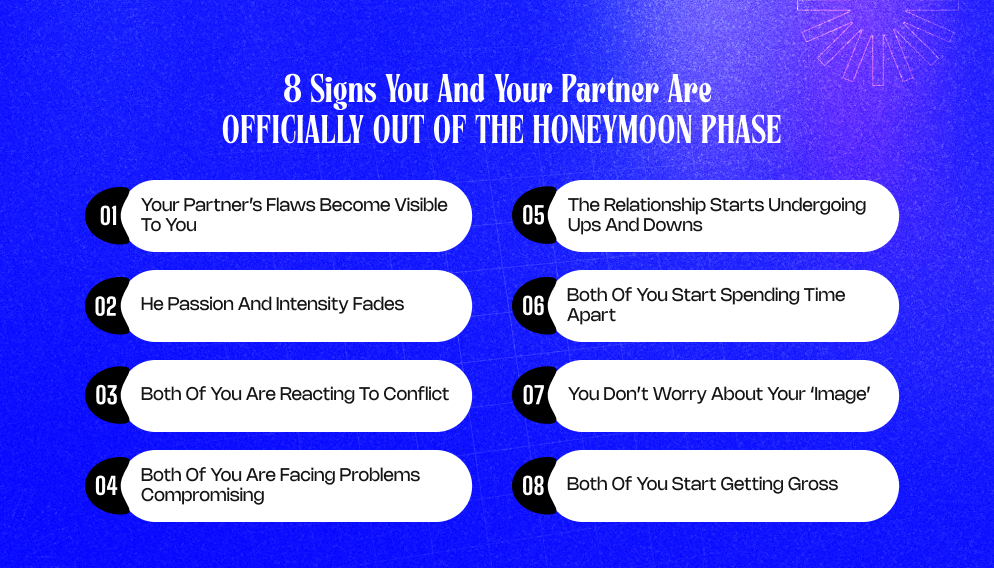
Your honeymoon phase will eventually end – and that is not always a bad thing. It may mean your relationship is transitioning into something more meaningful and serious.
Interestingly, as per a 2020 Frontiers in Psychology study, the feelings of love are initially maintained by a specific dopamine. And not just that, this is also true for the brain’s oxytocin-rich regions. This means that your brain is operating with a single motive: sustaining intense romantic feelings.
And there is no distinctively set period of time for those intoxicating emotions to run their course. It could last for three months or for two years. Considering that, how will you know if your feelings are based on early infatuation or genuine love?
In this context, Jonathan Bennett, certified counselor and founder of Double Trust Dating, told Bustle Magazine, “Although it sounds negative, the ending of the honeymoon phase can be positive. It allows you both to see each other openly and honestly and decide if the relationship is worth continuing. In addition, you can prolong the passion and happiness; it just takes more work. If you’re dating a great person, [they] should be more than willing to put in that effort!”
So, how will you know whether your relationship has survived the test of time and made it out of the honeymoon phase? When this phase actually ends, there are certain signs that will make things obvious – and in case you are confused, I’ve listed them below:
1. Your Partner’s Flaws Become Visible To You:
In the honeymoon phase, your brain chemicals work together to create intense feelings of attraction. This, in turn, leads to the ‘hal effect’ – you are so much in love that it makes you blind to the flaws of your partner.
But once this phase ends, you start to see your partner with more clarity – and the little things that seemed to be cute are suddenly annoying.
Also, this is a crossroads – you can choose to ignore the flaws and love them anyway, or you can see these negative traits as dealbreakers and move on.
2. The Passion And Intensity Fades:
Obviously, the honeymoon phase is all about spending time with your partner ALL THE TIME. Moreover, this phase is marked by intensity and intimacy.
For instance, my boyfriend travelled 12 km back and forth every day to meet me for an entire year – because we couldn’t stay away from each other.
But once this phase ends, you will start feeling less excited about spending time all the time – it does not indicate anything bad. It’s more about settling into a daily routine and building commitment in the midst of your everyday life.
3. Both Of You Are Reacting To Conflict:
Once both of you start getting on one another’s nerves, you will find yourself reacting more. In this case, ‘reacting’ means behaving impulsively without thinking, especially during conflict.
In this context, Marissa Nelson, a family and marriage therapist, told Bustle Magazine, “Couples many times work on autopilot. We are reacting to our partner from all of our life patterns, previous failures, and past hurts, and people don’t understand why their partner is not showing compassion or empathy, always thinking it’s the other person’s fault and never taking responsibility for the things we do that fuel the conflict and disconnection.”
So, it is vital that both of you try to look at things from each other’s perspectives.
4. Both Of You Are Facing Problems Compromising:
During the honeymoon phase, both of you will see that you will literally do anything for each other – making compromises seems like an easy affair.
For instance, my boyfriend left the examination hall to meet me and ended up failing the exam. And me? I cancelled on my boss and went on a 10-day couples’ trip. Needless to say, I lost my job.
But once the intensity fades, it’s all about meeting halfway – is he doing more or is it the other way around? More often than not, it’s become a sort of power struggle. In fact, it will take some time to weather such storms and settle down in the relationship.
5. The Relationship Starts Undergoing Ups And Downs:
Typically, in the initial weeks of a new relationship, there’s so much time at our disposal for our partner. But once you start settling down, you might become somewhat busier, and that is only normal.
Moreover, when your partner lets you down in some way, you get angry and start losing that intense connection. Instead, you start focusing your energy on protecting yourself.
In addition, you will find yourself pulling away, putting up walls, and even trying to change certain things about your partner.
Also, the moment you feel like you are under some sort of attack, you will start keeping score. It’s the time when you start having negative feelings and guarding your heart.
While it’s vital not to give more than you are getting in any relationship, it is crucial to be generous, especially in romantic dynamics. Moreover, because your dynamic might seem different on certain days, it doesn’t really mean anything bad for the relationship – it’s just a part of growing together.
6. Both Of You Start Spending Time Apart:
Having space between you and your partner is not a bad thing – in fact, I say it’s essential for building a solid relationship.
So, while it’s super easy to be around each other all the time initially, it is only normal to want (and give) space as the relationship progresses beyond this stage.
In this context, Jalesa Tucker, a content coordinator from One Love, told Bumble Magazine, “It’s incredibly important for both partners to maintain a sense of independence outside of their relationship. By engaging in activities independent of each other, couples are better able to maintain their sense of self and bring diverse experiences to their relationship.”
7. You Don’t Worry About Your ‘Image:’
Everything is super peachy in the first few months of the relationship. Everything is going well, and it might feel like nothing can go wrong.
Moreover, there is so much more effort in terms of your appearance and behavior. But once your relationship begins to progress and things become serious, the rose-colored glasses come off. And for the first time, both of you really see each other.
It is very normal to keep up with your image initially – look at it as a way of impressing your partner. But after some point, both of you will start accepting each other’s authentic versions. This includes negative traits and normal aspects of daily living.
8. Both Of You Start Getting Gross:
In the initial weeks, both of you are infatuated, and everything in the relationship is nothing less than picturesque. However, once the honeymoon phase ends, things start getting gross. And it’s very cute!
Once you start knowing your partner better, you will see them as their most authentic selves – grossness and everything else. For instance, things like getting sick, burping, and using the washroom will start feeling normal.