
There’s a point in dating where things should naturally move forward. You talk regularly. You feel comfortable. There’s some emotional investment.
And then it stalls. Of course, not in an obvious way. Nothing really breaks. Moreover, there is no big fight or clear rejection.
Instead, there’s just hesitation, delays, and vague answers. That’s where the fear of commitment usually comes up.
But here’s the problem: people use that phrase to explain everything, and that’s why it’s so hard to know what’s actually going on.
So instead of asking “Do they have commitment issues?”, a better question is: “What does their behavior actually lead to for me?” Because that’s what affects your life.
And today, I’m going to address this fear in my blog – why? Because it’s super common, and while we use the phrase to explain certain behavioral patterns, we never directly address it.
So, here I’m – my point?
To dissect the grassroots reality behind such a fear, considering commitment plays a crucial role in modern love and dating.
Stay tuned.
What Fear Of Commitment Really Looks Like (Not The Stereotype)?
Forget the idea of someone who avoids relationships completely – that is not always how fear of commitment looks in real life.
TBH, in real life, it often looks like this: They let things grow to a point.
So, they invest just enough for you to feel something real. Then they slow down when things need definition or direction.
Moreover, you might notice:
- They are consistent until deeper conversations come up.
- They avoid labels, even after months.
- Moreover, they say they “don’t want to rush,” but nothing progresses.
- They open up emotionally, then pull back right after.
As a result, it is not a lack of connection. Instead, it’s a lack of follow-through when the connection asks for stability.
Why This Pattern Happens (In A Way That Actually Makes Sense)?
Most people don’t wake up and decide to avoid commitment. Moreover, having a fear of commitment is not something people are conscious of from day 1.
It is just something that keeps happening like a pattern before someone can even realize they are having commitment issues.
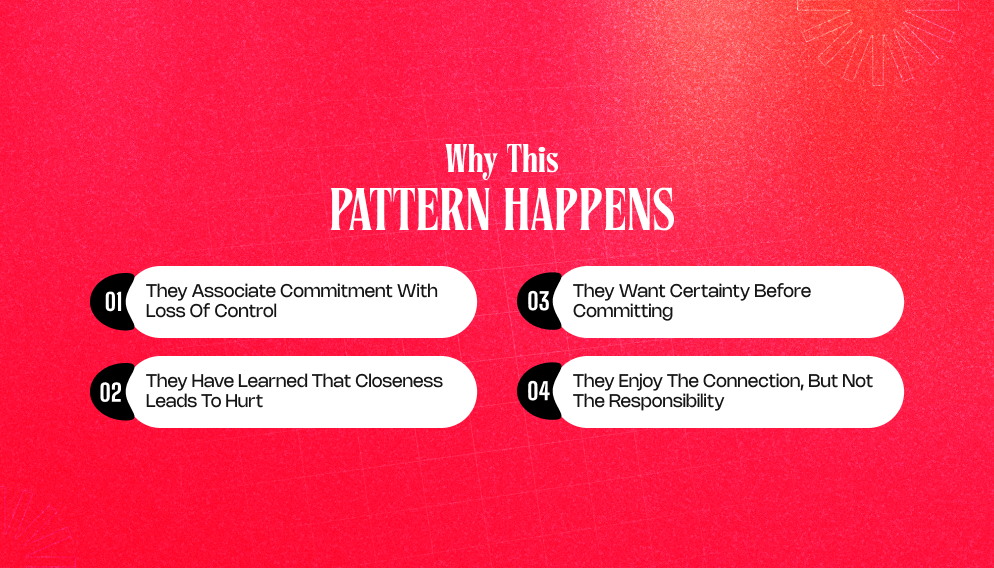
Also, it is usually tied to how they experience risk. On that note, here’s why people face fear of commitment.
Of course, there could be other deeper reasons, but the reasons I’ve laid out below are your primary pointers.
1. They Associate Commitment With Loss Of Control:
For some people, commitment feels like giving something up. It could be their freedom, time, or even independence.
So even if they like you, part of them resists going “all in” because it feels like closing other doors.
2. They Have Learned That Closeness Leads To Hurt:
Past experiences matter here.
So, if someone has been hurt, rejected, or emotionally drained before, they may connect intimacy with pain.
As a result, when things start to feel real, their instinct is not to settle. Instead, it’s to protect themselves.
3. They Want Certainty Before Committing:
Now, this is unrealistic.
Of course, some people wait until they feel 100% sure. They don’t want any doubts or risks. But relationships don’t work like that.
So they stay in a loop of “almost ready,” without ever moving forward.
4. They Enjoy The Connection, But Not The Responsibility:
This is the part most people ignore.
Sometimes, it’s not deep fear. So, they like you. Moreover, they like talking to you – they like how you make them feel.
But they don’t want to take on the expectations that come with commitment.
As a result, they stay in the middle.
Also Check: What Is A Monogamous Relationship? Has Monogamy Evolved In 2026?
The Real Problem: It Creates A One-Sided Waiting Game
This is where anyone ends up getting stuck.
When you are with someone who has a fear of commitment, you are stuck in this one-sided waiting game that will probably never end.
Because from your side, it feels like:
- “We’re so close to something real.”
- “They just need more time.”
- “I don’t want to ruin it by pushing.”
So they wait. And while they are waiting, they adjust themselves:
- They ask for less.
- They ignore their own needs.
- Also, they accept uncertainty as “normal.”
That’s the real cost of dealing with commitment fear. Not the label, but the slow lowering of your own standards.
How To Tell If It’s Fear Or Just Lack Of Intention?
This is one of the most useful distinctions you can give your reader.
Because the response should be different.
It might be real fear if:
- They communicate openly about their hesitation.
- They still make a consistent effort.
- Moreover, they move forward slowly but clearly.
- They don’t disappear when things get serious.
There’s resistance, but also an effort to work through it.
Also, it’s likely not fair if:
- Everything stays vague for a long time.
- They avoid conversations about the future entirely
- Their effort drops when things deepen.
- You feel like you’re the only one trying to “move things forward.”
That’s not fear being worked through. Instead, that’s avoidance being maintained.
What You Can Actually Do (Without Overthinking It)?
This is where most advice becomes useless, so let’s keep it practical.
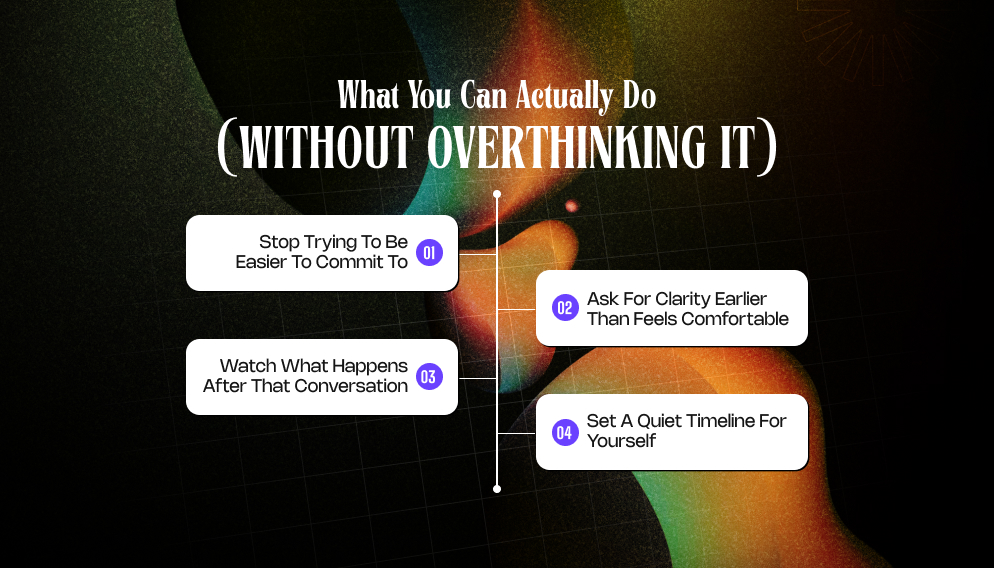
1. Stop Trying To Be Easier To Commit To:
This happens subtly.
You become more flexible, more understanding, and less vocal about what you want. But commitment doesn’t come from you being low-maintenance.
Also, it comes from the other person being ready and willing.
2. Ask For Clarity Earlier Than Feels Comfortable:
When you are asking for clarity, ensure you are asking not aggressively, but just clearly. So, something as simple as: “What are you looking for right now?”
Or later, “Do you see this moving forward?”
That way, you are not forcing a commitment. Instead, you are checking the direction.
3. Watch What Happens After That Conversation:
This is key. Just wait for a moment and ask:
- Do they give a real answer?
- Do they take steps to align with it?
- Or do they stay vague and unchanged?
Their response matters more than the answer itself.
4. Set A Quiet Timeline For Yourself:
It is not an ultimatum you announce. Instead, it is a boundary you keep. As a result, ask yourself: “If this still feels the same in 2–3 months, am I okay staying?”
If the answer is no, don’t ignore that.
The Mindset Shift That Changes Everything:
Instead of asking, “How do I make them ready?” start asking, “Is this dynamic working for me?”
And that one shift pulls you out of waiting mode. Why? Because the focus moves from their hesitation to your experience.
Moreover, you have to understand that a fear of commitment is real. But from your side, it doesn’t change the outcome.
As a result, if someone cannot meet you with clarity and consistency, the result is the same, whether it’s fear or disinterest.
You still end up in something uncertain. And uncertainty, over time, drains more than it gives. So the goal isn’t to diagnose them perfectly. It’s to recognize when you’re no longer moving forward, and decide what you want to do about that.
Additional Resource: If They Are Hot And Cold, Read This Before You Chase Again