As a self-proclaimed Instagram addict, I’ve been coming across dating trends forever – and for the longest time, I didn’t care.
Maybe it was hardballing. Maybe it was loud-looking. Perhaps someone complained about being breadcrumbed, trapped in a situationship, or caught in a delusionship.
At this point, modern dating has developed its own dictionary.
Every few months, a new term appears. People discuss it online. Articles explain it. Then there’s a new trend, which is suddenly what everyone is talking about.
And while I’ve spent years dismissing these trends and not paying any attention to them, the truth? They matter, and ignoring them would be crazy!
Because underneath the catchy names and social media discussions, these trends reveal something important about how people are dating today.
Frankly, these are not just some words that will disappear – rather, they are about uncertainty. They’re about changing expectations.
And they’re about people trying to make sense of a dating landscape that often feels more complicated than ever before.
Why Does Every Dating Behavior Have A Name Now?

My early 20s were certainly a rollercoaster ride.
Dotted with flings and casual relationships, everything was more or less similar. But just a few years ago, things suddenly started changing.
I was very surprised to see the emergence of terms like orbiting, breadcrumbing, and even ghosting.
The trust? The behaviors existed, but the labels didn’t. If someone stopped calling, they simply stopped calling.
If someone wasn’t interested, you eventually figured it out.
Honestly, I was surprised to find out that modern dating looks very different. Of course, technological interference has only made things more appealing with new ways of avoiding commitment, sending mixed signals, and keeping things super vague.
Today, someone can:
- Watch all your stories.
- Like your photos.
- Reply occasionally.
- Text once every few weeks.
And still never actually ask you on a date. That kind of behavior didn’t have a name twenty years ago. Now it does.
In many ways, dating trends are simply people trying to describe experiences that have become increasingly common.
The Biggest Dating Trends Of 2026:
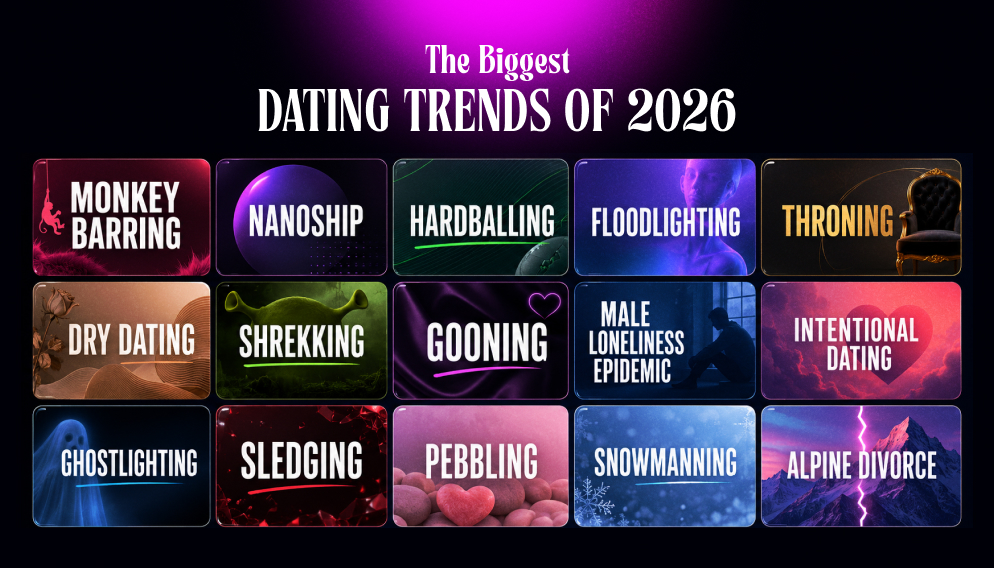
Some trends will disappear within months. Others reveal larger shifts that are likely here to stay.
Having said that, let’s look at the ones generating the most attention.
1. Monkey Barring:

Amie Leadingham, a relationship coach, defined monkey barring in a published blog by Cosmopolitan.
“Monkey barring is a toxic dating behavior where someone maintains their current relationship while actively seeking out and forming a love connection with someone new, with the intention of leaving their current partner for this new person.
Just like when swinging on monkey bars, they don’t let go of one relationship until they have a firm grip on the next one. They’re essentially shopping for their partner’s replacement while keeping them in the dark about it.”
Does it sound a lot like cheating? Hmm, truthfully, it does because it is possible that your former partner has monkey-barred you out of your relationship.
I remember how my former partner told all our mutual friends I had cheated on him because I was dating someone I had spent a lot of time with before the relationship had ended.
However, what counts as cheating is very subjective – it differs from person to person and relationship to relationship.
Having said that, it is also true that monkey barring from a relationship is inherently deceitful. Then why do we do it in the first place?
Read the full article here: Monkey Barring: The Newest ‘Toxic’ Dating Trend That Is Screwing Us Up!
2. Nanoship:

For starters, one thing is dead obvious – nanoships are obviously less ‘serious’ in nature than situationships.
Microconnections have been ruling the dating landscape for years now, thanks to our tragic (and lasting) situationships. And we thought flexible relationships that can mold and transform as the situation deems fit are perfect for our fast-paced modern lives.
But it seems like even that is not working – and we have something even more convenient. Meet nanoships – and trust me on this one, we have all had those!
This basically focuses on connections that are fleeting but impactful. It’s like a sweet aftertaste that stays with you for a long time, although you don’t really go back for more.
Yeah, this dating trend is entirely free from long-term commitment. Unlike conventional dating, nanoships are all about spontaneity – about living in the moment!
So, it could be an intriguing conversation with a stranger at the metro, or a sudden electric moment with your manager by the coffee machine.
Moreover, these intense and equally temporary moments offer a unique blend of emotional resonance and excitement without the pressure of a serious or traditional relationship.
But why is this term suddenly everywhere? It was Tinder’s Year In Swipe report, published at the end of 2024, that highlighted the emerging dating trends of 2025 – and nanoship was one of those trends.
Naturally, this trend is here to stay, considering it is an objective reflection of a world that loves small interactions and impactful moments. Also, nanoships offer companionships to people seeking intimacy or love without commitment or expectations.
Read the full article here: Nanoships: Is Tinder’s New Dating Trend Glorifying Escapism?
3. Hardballing:

Hardballing is all about being open about your wants, needs, and intentions in dating. So, it’s more like going straight to the point instead of beating around the bush when discussing hard topics.
Moreover, it’s also about not wasting time – why wait for someone to match your pace when you can find someone who is on the same page as you? It’s all about setting the tone romantically with a straightforward take-it-or-leave-it approach.
And if you think about it, we have all reached this point in our relationships, especially while seeking long-term partnerships. But hardballing tends to be somewhat more intense than traditional and intentional dating.
Read the full article here: Does Hardballing Actually Work In The Modern Dating Landscape?
4. Floodlighting:

There’s only so much that you can share on your first date with someone – like where you are from, what you plan on ordering, and stuff like that.
Moreover, you can talk about your interests, background, and hobbies. And then if the conversation is flowing organically, there can be a few TMI moments, like how you did something crazy on your last vacation.
And then there’s direct trauma-dumping, A.K.A. floodlighting.
Brené Brown actually used the word in her book, ‘Daring Greatly: How the Courage to Be Vulnerable Transforms the Way We Live, Love, Parent, and Lead.’
Moreover, so many people have been using this term on social media while sharing their floodlighting stories and experiences – how their not-yet-significant others have floodlighted them in casual interactions and even on dates.
The term ‘floodlighting’ involves sharing very intimate, personal, and highly emotional details about yourself too soon in dating or even in relationships, especially when both parties have not established a mutual connection and trust.
For instance, imagine talking about your expectations from a relationship or how your former partner cheated on you. This becomes more true when a person intentionally overshares – the person is not accidentally letting out personal details. Rather, it’s intentional.
You can check the full article here: What Is Floodlighting? Oversharing On The First Date Isn’t Cool Anymore!
5. Throning:

Kesley Wonderlin, a therapist and dating coach, defined throning with Cosmopolitan.
During her discussion, she said, “throning is when you intentionally date someone with social clout, influence, or popularity to boost your own image and social standing. The focus is on the benefits of being associated with your partner, rather than being with your partner as an individual.”
So, you are essentially putting your date on a throne, or a pedestal. It’s the same as dating or marrying someone for climbing the social ladder – it could be for an elevated social class or clout.
While this trend is literally what kings and kingdoms thrived on hundreds of years ago, the modern dating subculture makes it part of concepts like high-value dating.
FYI, high-value dating is all about encouraging singles to go for high-value mates. Here, value is typically determined by social clout, looks, and obviously, money!
If it does sound somewhat toxic, many people would actually agree with you.
And while being treated like a prize doesn’t sound bad, especially for people who have never felt appreciated in relationships, it is vital to remember that all the praise is actually performative. And we all know that performance does wear off – it doesn’t really last!
Moreover, even if someone is publicly bombarding you with attention, they might make you feel unappreciated and unseen behind closed doors.
Also, after a while, you will realize that someone is only chasing you for different superficial reasons. It is normal to question your worth – are you only worth what you offer externally?
Read the full article here: Throning: Is This ‘New’ Dating Trend Ruining Romance?
6. Dry Dating:

Essentially, dry dating is about knowing someone within a romantic set-up without indulging in alcohol. This is a shift in the dating landscape and has managed to gain a significant amount of popularity.
Post-COVID, this trend started gaining traction with millennials and Gen Zs switching to a healthier lifestyle. It is also about seeking a deep emotional connection by participating in sober meet-ups and dates. That way, you can understand potential partners better in the absence of external distractions.
Dry dating is a wholesome and refreshing approach in the modern dating landscape. This is because it offers people the space to build genuine connections. Moreover, it creates the space to know people better and have meaningful conversations.
In addition, dry dating also offers a safer and more responsible space to meet new people and interact with them. As per Bumble’s survey, 34% of respondents across the globe said that they are more likely to go on dry dates now as compared to pre-COVID years.
This approach easily aligns with the present health-conscious mindset in the youth since it promotes conscious and mindful drinking. No wonder it’s quickly gaining popularity, especially amongst the younger crowd.
Read the full article here: Dry Dating: Is This Healthy Dating Trend Changing How We View Modern Dating?
7. Shrekking:

Shrekking is basically what happens when people stop overdoing it.
You don’t text all day. You don’t feel the need to reply in five minutes. Also, you don’t rush to meet just because that’s what people expect.
Instead, you slow things down – on purpose. Not in a manipulative way. Just in a “I have a life outside this chat” kind of way. And weirdly, that works better.
Read the full article here: Shrekking: The Dating Trend For People Who Are Tired Of Trying Too Hard
8. Gooning:

Gooning, ah! The fetish of the year, as per Clips4Sale.
At its core, gooning is about getting deeply absorbed in a loop of stimulation – usually digital and repetitive.
Moreover, it is ideally designed to keep your attention locked in for longer than you planned.
It’s less about one moment and more about the state of it. Losing track of time. Staying longer than intended. Also, going back to it again and again.
You don’t always notice it while it’s happening. Instead, you notice it after.
Read the full article here: Gooning: The Dating-Age Habit No One Talks About (But It’s Affecting How People Connect)
9. Male loneliness epidemic:

As per a recent survey by Pew, 16% of men said they were lonely most of the time. The key causes in this case include the relative scarcity of friendships among men compared to women.
Considering that men are generally encouraged to be strong rather than vulnerable, it can be difficult for them to express emotions and have meaningful interactions with others. And this includes their romantic partners.
This doesn’t end here. Apparently, there’s the misogynistic and addictive manosphere that targets young men and boys, in a world where conventional gender roles and masculinity are contested regularly.
Plus, many boys and young men are actively seeking purpose in an evolving society where women are constantly excelling and outpacing them – both at school and work.
Having said that, it is not fair to use gender as a parameter for determining loneliness. And I have evidence. According to a 2020 survey of adults from 237 countries, it was discovered that culture, gender, and age interacted to predict loneliness.
In addition, male loneliness isn’t exactly new. Rather, the sharp increase in suicide rates in men as compared to women has made this front-page news.
Again, I can support this fact with data. In a study published in 2009, suicide rates among young adults aged between 15 and 24 in 15 different European countries were between 5.5% and 35.1% in males. In women, the rate ranged from 1.3% to 8.5%.
These findings don’t invalidate the male loneliness epidemic. Instead, they contextualize – not to mention, temper – the current frenzy by offering evidence that demonstrates that men have been lonely for a long time.
There might be different reasons, but it is definitely not their only rodeo – and they aren’t the only ones who feel this way.
Read the full article here: Stop Talking About The Male Loneliness Epidemic: It’s Not Our Problem Really!
10. Intentional Dating:

Intentional dating is just honesty, applied early. That’s it.
There’s no framework or complicated rules. Instead, you know what you want. And more importantly, you are not afraid to say it.
Then you act as if it matters.
So, if you want something long-term, you don’t treat it like something casual. You don’t accept half-effort and hope it becomes more.
And if you don’t know what you want yet, you say that too. Clarity is the whole point – and as long as you are honest about your intentions, you are fine.
For me, personally, intentional dating is a much more stable and healthy approach to modern love – and I’ve always practiced it in my life.
Read the full article here: Intentional Dating Is The Healthiest Approach To Modern Dating
11. Ghostlighting:

Ghostlighting happens when someone fades in and out, but denies the impact of it.
You will see them disappearing. Then come back as if nothing happened. And when you bring it up, they dismiss it with either of these one-liners:
- “You’re overthinking.”
- “I’ve just been busy.”
- “It’s not a big deal.”
But it is a pattern. And over time, that pattern makes you question your reaction.
Read the full article here: Ghostlighting Is Toxic, And We Are Staying Away From It.
12. Sledging:

The term ‘Sledging’ has been derived from the literal action of dragging a British ‘sledge’ through snow.
In this case, the implication is that a sledger is dragging you along through snow during winter with any actual intention of building something meaningful.
Interestingly, many of us are under the impression that cuffing season usually arrives with fall and winter and ends with spring or summer.
But there seems to be a primary distinction between sledging and cuffing.
Cuffing relationships are mostly open-ended with the potential to progress into something long-term that can last beyond winter. So, while the cuffing season organically ends before spring or summer, the actual distinction is all about intent.
If the plan was to simply end things at the end of winter, so you are not alone during the holidays, then that is not cuffing. Instead, it’s sledging.
Having said that, I do think that in the majority of cases, it is not as sadistic as it might sound right now.
Read the full article here: Sledging: What It Is, Why It Happens, And Where The Line Is?
13. Pebbling:

On paper, pebbling is simple – you send small things that remind you of someone. But that definition misses the point.
The real impact is not the content. Instead, it’s the timing and the specificity.
Moreover, it’s getting something at 2:13 PM on a random Tuesday and realizing, “Okay, I exist in their head outside of our conversations.”
That’s what lands.
Because most of modern dating doesn’t feel like that. Instead, it feels segmented. You talk, then you disappear into your own lives, then you come back and pick it up again.
And pebbling breaks that pattern in a quiet way. Also, it fills the gaps without making a big deal out of it.
Read the full article here: Pebbling In Dating: The Small Gesture That Builds Real Connection
14. Snowmanning:

Unlike ghosting, which is abrupt, snowmanning is gradual.
It’s not someone disappearing overnight. It’s someone slowly reducing effort after building a certain level of connection.
So, you can think of it like this:
- In the beginning, they show up fully.
- Then they start showing up… slightly less.
- Then just enough to keep things from ending.
There’s no clear break. No clean ending. Just a steady decline. And that’s what makes it confusing.
Because technically, they are still there.
Read the full article here: Snowmanning: When Someone Builds Something With You, Only To Slowly Step Out Of It
15. Alpine Divorce:

People on the internet, specifically TikTok and Instagram, have been using ‘alpine divorce’ as a phrase to discuss what @EverAfterIya posted on 18th February (on TikTok), earlier this year.
So, for the ones who don’t know, this post was able to garner over 19 million views – it featured one woman stranded on a rocky trail. She was weeping while calling the day, “The worst Saturday of my life.”
Moreover, the video came with a text overlay that stated, “POV: you go on a hike with him in the mountains, but he leaves you alone by yourself, and you realize he never liked you to begin with.”
Yeah, abandoning your partner during a hike sounds like a horrible thing to do.
Originally, the term first appeared in a short story, called ‘Alpine Divorce,’ that Robert Barr wrote in 1893.
Things get much darker when you look at the story’s origins. In Barr’s tale, a man travels through the Swiss Alps with his wife while secretly planning to kill her.
Naturally, this term has become an alias for abandoning your partner in an outdoor remote setting.
This generally leads to the relationship ending – I mean, who would want to be with such a person!
Moreover, once @EverAfterlya posted about this, it prompted others to come forward with their experiences.
Read the full article here: Alpine Divorce: Why Hikers Say It Reveals The Truth About Relationships?
Are Dating Trends Actually Helpful?

In my opinion, trends are an inevitable aspect of anything and everything you do. As a result, if you think you can avoid dating trends in 2026, you are lying to yourself.
And just because something is trending, it doesn’t necessarily always have a positive indication – sometimes, it can be super negative as well.
For me, trends are something I like keeping up with – whether it’s the latest trends in dating, pop culture, or even real estate, I love keeping up.
What I’ve seen so far is on the positive side; you will see that these trends and labels actually can be helpful, even if they are negative. How? You can identify what’s toxic and unhealthy just with the right amount of awareness.
Someone who experiences breadcrumbing may finally realize why a connection feels confusing.
Someone stuck in a situationship may find language for what they’re experiencing. That can be empowering – you literally don’t need to go through an experience to identify something.
But there is another side. Not every disappointing interaction needs a label. Not every awkward date represents a trend.
Sometimes two people simply aren’t compatible.
Modern dating culture occasionally risks turning ordinary experiences into complicated theories. The healthiest approach usually falls somewhere in the middle.
Understand the trends. But don’t let them define every interaction.
What Dating Experts Expect Next?
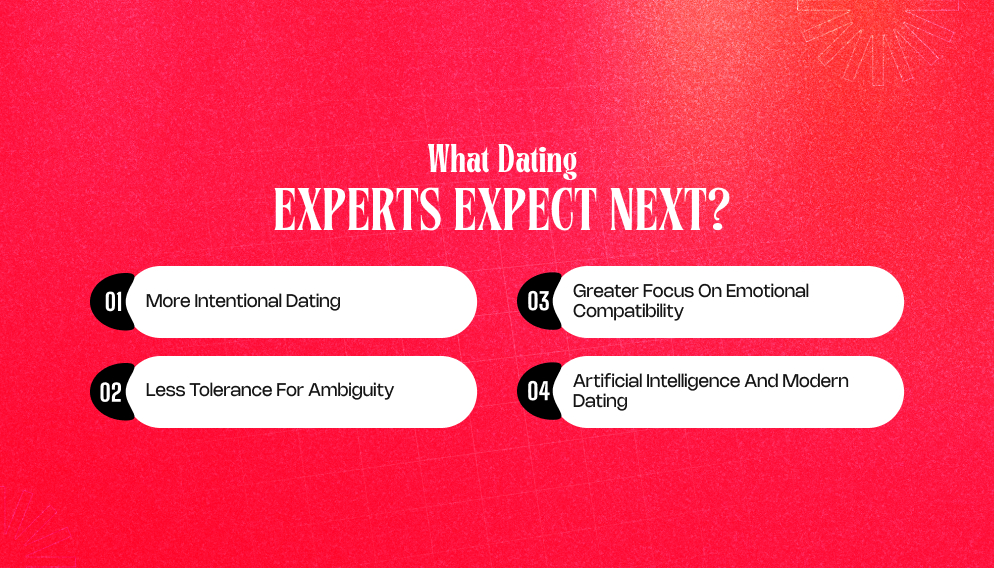
While specific buzzwords will come and go, several larger trends appear likely to continue.
Based on my experience and what I found on the internet, here’s what dating experts are expecting to happen in the next 12 months:
1. More Intentional Dating:
This is absolutely true – people no longer care about how many dates they go on. It’s more about who they are going with – and whether they are worth their time and energy. Intentional dating will likely continue growing.
2. Less Tolerance For Ambiguity:
Hardballing and loud looking suggest that many daters are losing patience with mixed signals.
Clear communication may become increasingly valued.
3. Greater Focus On Emotional Compatibility:
Attraction still matters. But emotional intelligence, communication skills, and shared values are becoming bigger priorities – sometimes what’s inside you is more important than your face card.
4. Artificial Intelligence And Modern Dating:
AI already influences dating apps through matching systems and recommendation algorithms. Its role will likely expand. That doesn’t mean technology will replace human connection. But it will continue shaping how people meet and interact.
What Modern Dating Is Really Telling Us?
It’s tempting to laugh at dating buzzwords.
Some of them certainly sound ridiculous. Yet the popularity of these terms reveals something surprisingly human.
People are trying to understand their experiences.
They are looking for language that helps explain confusion, disappointment, hope, attraction, and connection.
The names may change. The apps may change. And the trends will definitely change. But the underlying goals remain remarkably familiar.
People still want honesty. They still want a connection. They still want to feel understood. And despite all the new terminology, modern love isn’t as different as it first appears. The vocabulary has evolved. Human nature hasn’t.