
There’s literally no class in university or high school about how to not be a toxic and unhealthy partner. Sure, they teach you about sex, a few classic love stories from the 18th century, and in some cases, the legalities of marriage.
But what are the signs of a toxic relationship, or how to be a good boyfriend/girlfriend? Not really. Without any clarity and awareness, we are left with trial and error – and for most people, it’s primarily error.
Enter: a bunch of unhealthy, toxic relationships that are bound to fail after traumatizing your forever. But that is not the real problem.
The real issue is how so many toxic relationship patterns are rooted in our society and culture – it’s almost normalized. I mean, we are the same people who found The Notebook romantic.
In fact, we were big fans of Twilight and Fifty Shades of Grey – essentially, all are examples of how we worship love that is irrational and dizzy, with zero respect for healthy boundaries and soft love.
And not just that, we are the same people who scoff at unconventional sexualities and practicality. Plus, self-help books are not helpful when it comes to helping us identify toxic relationships, and for so many of us, our parents didn’t really set a good example.
Then, where does it leave us? A generation that has no idea about dealing with toxic, unhealthy, and potentially abusive relationships, because being alone is worse, and finding love is the only ambition.
On that note, stay with me while I navigate the most common signs of a toxic relationship and what to do instead of being stuck in one!
What Is A Toxic Relationship?

The idea about toxicity is subjective. I mean, most of us have our own set of toxic traits. So, it inherently depends on whether someone is fine with it or not, especially in a relationship.
For instance, I dated a guy for eight months and broke up with him because I found him toxic – whatever he did, especially how he reacted when he was angry, made me scared and borderline anxious.
Later, I realized he was emotionally abusing me, and I was letting it happen for eight months before I could muster some courage and break free.
Six months later, I met my current partner, and it has been nearly 7 years since then. In the past 6 years, 11 months, we did have many fights – many of which you can brand as toxic and unnecessary. But both of us thought we could evolve, grow, and strengthen our relationship.
One thing is obvious from these two situations: toxic relationships are rooted in the absence of three primary elements of any healthy relationship:
- Trust,
- Respect, and
- Affection.
In the absence of these three elements, you cannot have a healthy relationship. And that is precisely what was missing from my first relationship.
Love Is Not Enough:
It might sound maddening to some of you, but love alone can never really be enough. It can cloud your judgment (as it did for me), but at some point, you will understand that love is not reason enough to be with someone.
So, if you have been prioritizing a love that you can get from a relationship over your self-respect, then you must be fine with being a doormat. Moreover, if you have been prioritizing love over your partner’s trust, then you will be fine with disrespect, lying, and even cheating.
Also, all of us have tolerated unhealthy relationships at some point – maybe because we don’t love ourselves enough, maybe because we suffer from low self-respect, or perhaps we don’t know how to handle our emotions.
But all of this does end up creating a psychologically unhealthy, superficial, and even abusive relationship to an extent.
Signs You Are In A Toxic Relationship (And What To Do Instead?)
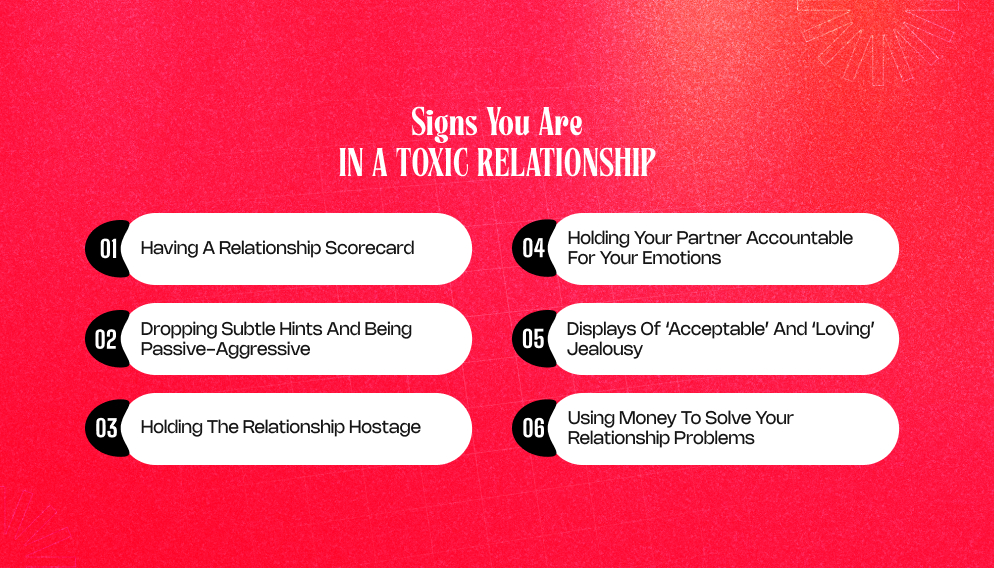
As I was saying, toxicity is subjective. And it can differ from relationship to relationship. Having said that, there are some telltale signs of a toxic relationship – like a handful of signs that together can make any relationship super toxic and abusive.
Worse, people can even assume that these signs are markers of a healthy and happy relationship.
On that note, here are some of the most common signs of a toxic relationship. Also, these signs are harmful and abusive, especially in long-term relationships.
1. Having A Relationship Scorecard:
We have all been there. Think about all the messy, chaotic fights you have had with your partner – do they keep a scorecard to highlight who has messed up more in the course of the relationship?
When two people in the relationship blame each other for past mistakes and keep score, the entire relationship ‘devolves’ into a game – rather, a battle – to highlight who has screwed up more in the past few years or months.
And not just that, it also highlights who is more indebted and obligated to the other.
For instance, you caught your partner sending flirty texts to his colleague late tonight. While that is not okay, he thinks it’s fine because you were rude to his parents two years ago. So, you guys are sort of even. Right? Nope – this is wrong!
Why Is This Toxic?
For starters, both of you are deflecting accountability for the present issue by prioritizing past mistakes.
Moreover, you are also retaining resentment and guilt from the previous years and gaslighting yout partner into feeling shitty for the present – and it is probably happening to both of you.
So, instead of working towards a solution, both of you are spending your energy proving to each other who’s the better person. Also, you are essentially spending energy and time proving you are relatively less wrong instead of trying to be a better person.
What Can You Do Instead?
It is best to solve problems individually, unless these issues are connected legitimately. So, if someone cheats habitually, then you have to understand it is a recurring issue.
But that has nothing to do with you being rude to your partner’s parents years ago. As a result, there’s no point bringing it up while discussing the cheating.
Moreover, it is vital to understand that when you choose to be with someone, you are choosing to be with them, considering all previous behaviors and actions.
So, it’s not fair to bring it up weeks, months, and years later. In fact, if the issue had bothered you at the time, then you should have dealt with it then and moved on.
2. Dropping Subtle Hints And Being Passive-Aggressive:
Instead of having a transparent and honest conversation, if your partner just acts passive-aggressively or drops subtle hints that they are upset with you, then it’s a major red flag.
Someone who is upset with you can just say it out loud, and then both of you can work towards a solution. However, most toxic couples fail to have honest and transparent discussions.
Instead of saying what is really upsetting them, they will just find petty and small ways to piss you off. Why? To justify the subsequent reaction.
For instance, you go to a party with your friends, come back home late, and forget to call them at night. In the morning, when you call them, they might not directly tell you they are upset.
Instead, they might act petty about something small and drop subtle hints – in fact, they might even fight with you over something small, like not replying to an Instagram reel they had sent to you at night.
And you know, they are upset over something bigger. But since they refuse to communicate, you can’t do much about it.
Why Is This Toxic?
This is inherently toxic – why? Because it highlights that neither of you is comfortable enough to have an open and clear conversation.
Think about it: why would someone become passive-aggressive when they can safely express their insecurity or anger in a relationship? In fact, you (or your partner) need not drop any subtle hints if you don’t criticize or judge them for being honest.
The fact that you or your partner cannot be transparent with each other highlights the toxicity and lack of a safe space within the relationship.
What Can You Do Instead?
The only solution is to communicate your desires, feelings, and needs openly. While doing so, make it very clear that your partner is not necessarily obligated or responsible for those feelings. But you do need their love and support – the reassurance that they understand you.
Also, if they are in love with you, then they will almost always support you – no matter what! So, forget about subtlety and passive aggressiveness. Just be your honest, transparent self.
3. Holding The Relationship Hostage:
This one’s so normalized we don’t even notice it most of the time. If you have a simple complaint or criticism about your partner, and decide to voice it to them, you expect them to listen – at least think about it, right?
But instead they tell you, they are just like this and they will never change – you have to take it or leave it.
So, when your partner responds to your complaint by threatening the entire relationship, your partner is essentially holding the relationship hostage.
I’ll show you how it works with an example. For instance, if you feel that your partner tends to get distant at times and tell him about it, you are expecting him to listen and reflect. Instead, he responds with, “I have been like this all my life. I can’t be with someone who has a problem with this trait of mine.”
Of course, you will be taken aback and get anxious about the relationship’s future – but what about the hurt you feel inside? This is one of the biggest signs of a toxic relationship.
Why Is This Toxic?
This is undoubtedly toxic, and I’ll tell you why! When your partner holds a relationship hostage, it leads to a sort of emotional blackmail and ends up creating a lot of unnecessary chaos and drama.
Even a small hiccup in the relationship’s daily flow and course can lead to a potential commitment crisis you were not expecting.
Moreover, it is vital for two people involved in the relationship to be aware of negative feelings and thoughts that can be safely communicated without threatening the relationship’s entire future.
Without the autonomy to be transparent and honest, any couple will start suppressing their true feelings and thoughts. This will lead to the development of an environment characterized by manipulation and distrust.
What Can You Do Instead?
It is fine to be upset with your partner. Also, it is fine, not like everything about them – you can love them, but that doesn’t mean you will like everything about them at all times. That is just being normal.
When you commit to someone, it doesn’t mean you will like everything about them. Yes, you can love someone forever, but that doesn’t mean things about them will not annoy and anger you.
Once in a while, your boyfriend’s behavior might annoy you. And you can tell them – at least in a normal, healthy relationship.
If two people cannot communicate their likes and dislikes without blackmail or judgment, their relationship will fail to grow and evolve.
4. Holding Your Partner Accountable For Your Emotions:
This one’s simple, really – and we do it all the time, so much so that most of the time, we don’t realize that it’s a super toxic thing to do. Didn’t understand what I was saying? Let me explain!
For instance, you are having a really bad day at work, and you come back home, seeking emotional intimacy and support. But you see that your partner is not being supportive and empathetic about it – maybe they are on the phone while you are talking.
Maybe they are distracted when you are sharing your feelings with them. It is also possible that you just want to lie in bed with them and watch something comforting, but instead, your partner has some plans that he has to attend.
Considering you are already upset and frustrated with how the day has panned out, your partner’s lack of empathy and distracted response will only increase your negative feelings.
And suddenly, you will see that you are lashing out at your partner. Why? Because of their potential insensitivity towards you.
Of course, you didn’t ask for emotional intimacy – you just wanted to hang out till you felt better. Needless to say, you were expecting your partner to know instinctively that you need them. As a result, it feels justified to scream at them for their lack of empathy for your emotional state.
Why Is This Toxic?
Holding our partner accountable for our emotions is a classic example of being selfish – it shows that our personal boundaries are poor and need an upgrade.
And when this is a pattern in your relationship, it clearly shows that the two of you are in a codependent relationship where everything needs to be negotiated. Moreover, the relationship lacks space for individual desires to grow.
The worst aspect of codependent relationships is how they cause resentment. Sure, if your boyfriend is upset with you sometimes because he had a bad day and you are not able to give him attention, it is understandable.
But if it grows into a massive expectation that your life revolves around his emotional wellness, then you will end up becoming bitter towards his emotions.
What Can You Do Instead?
Taking accountability for how you feel and just expecting that your partner will do the same for their emotions is the right thing to do.
Moreover, you have to understand that there is a subtle difference between supporting your partner’s emotions and feeling obligated to be there. If you or your partner makes a sacrifice for the other, it is a conscious choice – and not because there was a certain expectation to make the sacrifice.
The moment two people in a romantic relationship become accountable for one another’s emotions and moods, it creates space for both parties to start hiding how they truly feel. The result? Bitterness, resentment, and manipulation.
5. Displays Of ‘Acceptable’ And ‘Loving’ Jealousy:
Getting really pissed when your partner calls, texts, talks, or does anything in another person’s general vicinity and proceeding to lash out at them for being insensitive to you is extremely toxic.
I am sorry, but it is neither cute nor lovable to try to control someone’s general behavior. Of course, they can have friends of other genders – you have to trust your partner and let them make their own choices. Forbidding your boyfriend from talking to his female friends is not cool.
Moreover, going through your partner’s phone, logging into their social media, and even ending up outside their work with the intention to ‘find’ out something is inherently toxic.
Why Is This Toxic?
Surprisingly, some people consider such behavioral traits acts of affection. In fact, it is so internalized that most people think that if your partner is not jealous, then it means you don’t love them enough.
Moreover, it is absolutely crazy. Rather than loving someone enough to trust them, you are controlling their life, going to the extent of manipulating them. On top of that, when you show a lack of trust in your partner, it ends up creating unnecessary chaos in the relationship dynamic.
The worst part? It is extremely humiliating and demeaning. So, if your partner cannot trust you enough to be there for you, then it shows that either you are a liar or just incapable of exercising control over your impulses.
What Can You Do Instead?
The only thing you can do instead is to trust your partner completely. I know it seems like a radical idea because certain jealousies are natural. Having said that, excessive controlling behavior and jealousy are signs of your own unworthiness and insecurity.
Moreover, you should learn how to deal with these feelings instead of controlling your partner’s life. If you fail to fix this kind of jealousy, then you will end up pushing your partner away from you.
6. Using Money To Solve Your Relationship Problems:
Whenever there is a major issue or conflict in your relationship, instead of actually solving it, you end up covering it up.
With what? With gifts or a trip, or something that costs you money, that way, you are covering up conflict with good feelings and excitement. It could get worse – moving in because you are unable to solve a conflict, or getting married.
My best friend and her husband were experts when it came to using money to solve a problem. And you know where it got them? Very far: a big wedding followed by a bigger divorce only after a year of marriage.
And after filing for her divorce, my friend told me that the primary problem of the relationship was that both parties were guilty of using money to cover up their real issues.
Why Is This Toxic?
Using money to cover up things or brushing the actual issue under the carpet creates an unhealthy pattern in your relationship – it sets a toxic precedent. Also, the real issue will always re-emerge and possibly at a worse time.
For instance, if your boyfriend always buys you a gift when you get upset or just takes you out, he is not actually listening to your issue. Instead, he just ends up paying to solve the issue, and sooner or later, it becomes an unhealthy pattern in the relationship.
The end result? A checked-out boyfriend who feels like your ATM and you? An incessantly bitter girlfriend who feels unseen and unheard.
What Can You Do Instead?
Facing the issue as a team and dealing with it is the only way out. Suppose your partner has done something to betray your trust. Discuss with them how you can rebuild it. Rather, talk about the steps you can take to rebuild trust in your relationship.
Moreover, if your partner feels unappreciated or ignored, then talk about restoring those feelings. Essentially, choosing to communicate is the right thing to do instead of relying heavily on gifts and dates.
Having said that, it is crucial to understand that there is absolutely nothing wrong with doing something nice for your partner.
After you have resolved a fight, you can definitely take your partner out. But you cannot use these things to replace handling any underlying emotional problem.