
Why do people ghost? The answer isn’t clean, and that’s exactly why it hurts or why nobody really wants to address it.
Ghosting stays with you longer than it should – and while we talk a lot about it, do we ever wonder why? Not because the connection was deep. Sometimes it wasn’t.
Not because you were in love. Sometimes you barely knew them.
But it stays because nothing ended.
There’s no final message you can reread and slowly accept. No sentence that stings but makes sense. Instead, you are left with just a gap where something used to be.
And your brain hates gaps. So it starts building stories – maybe he is busy, maybe he is exhausted, maybe there’s someone else.
God, I hate it – your mind racing against time, cooking up stories like it’s a professional fiction writer.
So, I sat down today with one intention – to ensure that you or I never feel this way again. Stick with me while I break down why people ghost – the real reasons nobody admits.
Stay tuned.
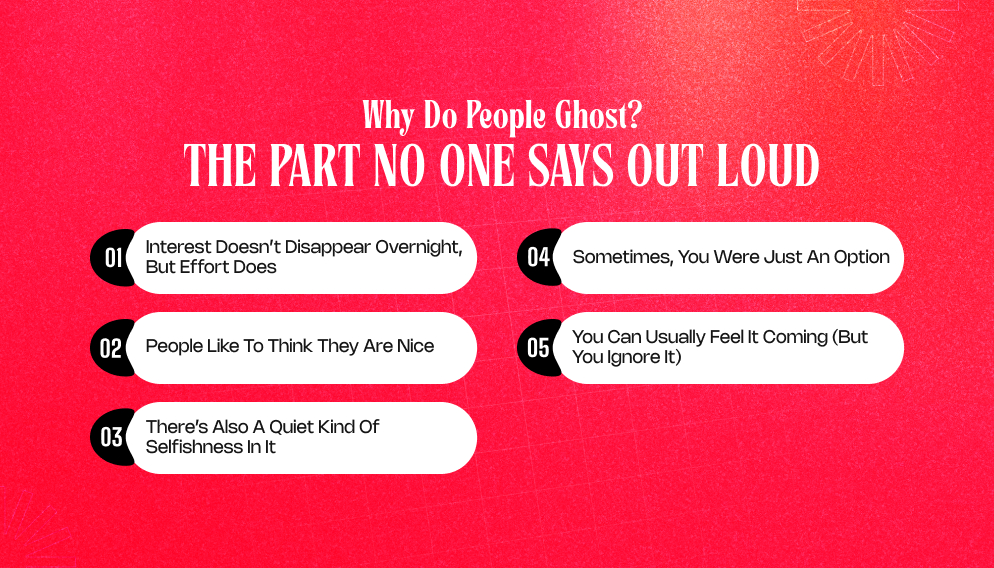
Why Do People Ghost? The Part No One Says Out Loud
Most people who ghost are not thinking about you as much as you think they are. That sounds harsh. But it explains a lot.
So, when they stop replying, they are not always sitting there debating the perfect way to end things.
Moreover, they are not drafting a message and deleting it ten times. More often, they just move on.
They get busy. They get distracted. Someone else catches their attention. Or their interest drops slightly, and that’s enough.
And instead of pausing to close the loop with you, they let the conversation die. Not because it’s right. But because it’s easy.
Also, I have covered detailed blogs on related topics for a better understanding of how unhealthy dating patterns play a role in modern love.
Now, let’s check out why people ghost – here’s what my understanding of human emotions love tells me.
1. Interest Doesn’t Disappear Overnight, But Effort Does:
So, here’s what usually happens, and it’s subtle.
At the start, there’s energy. It’s all about fast replies, curiosity, and obviously a bit of excitement.
Then something shifts. But not dramatically – just enough. Suddenly, they don’t feel like replying right away. So they wait.
Then they forget. Then replying starts to feel like a task. And once something feels like a task, people avoid it.
As a result, by the time they remember you again, too much time has passed. Now it feels awkward to come back. So they don’t.
From your side, it looks like a sudden disappearance. But from theirs, it felt like a slow fade they never addressed.
2. People Like To Think They Are Nice:
Very few people see themselves as someone who hurts others.
So instead of saying, “Hey, I’m not feeling this,” they choose silence and tell themselves it’s better.
They think it’ll be less dramatic this way, or we weren’t that serious anyway. What they are really doing is avoiding the moment where they have to be direct.
Because being direct forces you to take responsibility, ghosting avoids that responsibility completely.
3. There’s Also A Quiet Kind Of Selfishness In It:
Not the obvious kind. But the softer kind that’s harder to call out.
It sounds like this in their head:
- “I don’t owe an explanation.”
- “It wasn’t that deep.”
- “They’ll get the hint.”
And maybe, technically, they’re not wrong. But relationships don’t run on technicalities. Instead, they run on basic respect.
And disappearing without a word usually means they prioritized their comfort over your clarity.
4. Sometimes, You Were Just An Option:
This is uncomfortable, but it matters.
In a lot of modern dating scenarios, people are talking to multiple people at once – comparing, exploring, and keeping things open.
So when someone better aligned, or simply more exciting, comes along, the others fade out. Not because you did something wrong. But because you weren’t their first choice.
And instead of saying that out loud, they exit quietly. That’s ghosting in its most practical form.
5. You Can Usually Feel It Coming (But You Ignore It):
There’s often a moment before the silence.
If you have personal experience, as I do, you will know all the telltale signs:
- Replies get shorter.
- The energy drops.
- You start carrying the conversation.
Of course, you will notice it, but you will find yourself giving him the benefit of the doubt. Maybe he is busy. Maybe I’m overthinking.
Sometimes you are. But often, you are picking up on a real shift.
Remember, ghosting rarely comes out of nowhere. It just feels that way because you hoped it would correct itself.
Why Your Brain Won’t Let It Go?
Ghosting creates a loop.
You don’t have an answer, so your mind keeps searching for one. Moreover, you go back to old chats, you analyze tone, and you look for mixed signals.
You try to find the exact moment you lost them. But here’s the problem: you are trying to find logic in a situation that wasn’t handled logically.
They didn’t sit down and think this through clearly. So there isn’t any clear explanation waiting to be discovered.
That’s why it feels endless.
The Details Most Advice Skips:
Not every ghosting situation is deep or meaningful. Sometimes, it’s just low effort.
That’s just it – there’s nothing more to the story. Also, there’s no emotional struggle, confusion, or even hidden feelings in most cases.
Instead, it’s just one of those incidents where someone didn’t care enough to reply. It sounds blunt, but it’s freeing once you accept it.
Because it stops you from turning a small situation into a big personal question.
So What Do You Actually Do With This?
You don’t need a dramatic response. Moreover, you also don’t need closure from them to move on.
If you have sent one message and there’s no reply, you already have your answer – not in words, but in behavior.
And behavior is usually more honest anyway.
A Better Question To Ask Yourself:
Instead of asking, why did they ghost you, ask, “Do I want someone who handles things like this?”
That question is harder to avoid because it shifts the focus from being chosen to choosing.
TBH, ghosting feels like something unfinished. But if you look at it closely, it actually tells you something very complete. It shows you how someone deals with discomfort, communication, and basic respect. And once you see that clearly, you don’t need them to come back and explain anything.